There is a common misconception in the sailing world that performance trimarans, specifically ocean cruising trimarans like Rapidos, are reserved strictly for “advanced” sailors with decades of blue-water experience. Because these vessels easily hit double-digit speeds, onlookers assume they must be too complex or dangerous for a novice to handle.
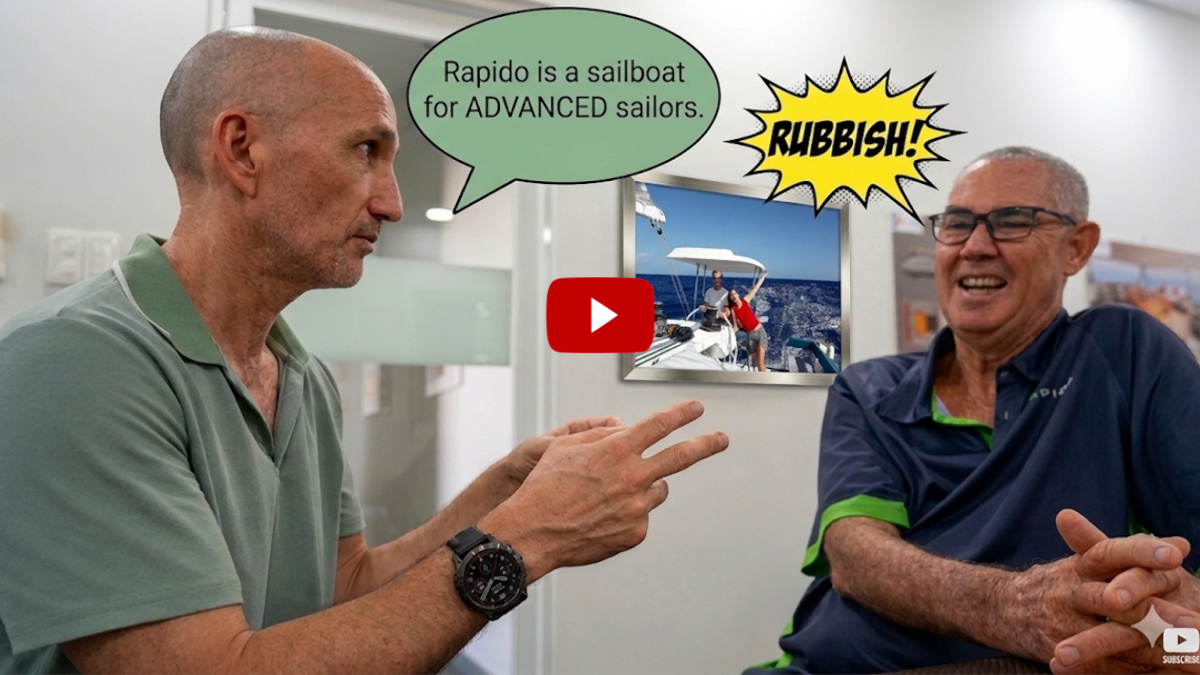
In a recent You Tube interview by Francis Tapon (click on the video image below) with Rapido Trimarans’ co-founder Paul Koch, this issue was addressed head-on.
- Why Koch dismisses this misconception as “Rubbish!”
- How a new owner with minimal sailing experience successfully single-handed a Rapido 40 over 1,000 miles – just a week after taking delivery; and
- Why a trimaran is actually safer and more predictable than a catamaran.
To play Francis Tapon’s video within this page, click above.
Below is a transcript of the interview from 21.32 mins that has been edited for clarity and space.
The Interview by Francis Tapon – “Rubbish!” replies, Paul Koch
Interviewer: Paul, a common critique of trimarans – and specifically Rapidos – is that they are built exclusively for “advanced sailors” with true, high-level seamanship. The narrative is that they are too complicated and cannot be handled by beginners. How do you respond to that?
Paul Koch: Rubbish!
Interviewer: Okay, defend yourself. Explain why you think it’s rubbish.
Paul Koch: To start with, a trimaran is significantly more stable than the average monohull. You aren’t constantly heeling over at the same angles. Sure, you do need to learn when to reef the sails. If it’s blowing 20 knots, you do need to put a reef in. But other than that, it handles just like any other sailboat.
Interviewer: Where do you think that “expert-only” criticism originally comes from?
Paul Koch: People are just scared of the performance capabilities. Performance can be intimidating if you aren’t used to it.
But it doesn’t have to be that way. The gentleman who bought the very first Rapido 40 – I saw him just a couple of weeks ago – he bought it about three or four years ago and absolutely loves it…
Interviewer: Was he a novice when he bought it?
Paul Koch: He had sailed, maybe, one month in his entire life and he was 71 years old at the time. He was an engineer by trade, a very smart guy who spent his life installing ski lifts and hanging out of helicopters, so he wasn’t easily rattled but he was undeniably a sailing novice.
Anyway, I sailed the first 300-mile delivery leg with him from our factory in Vietnam to Terengganu, Malaysia. Right after that, he single-handed the boat from Malaysia to Phuket, Thailand. That’s a journey of over 1,000 miles, entirely on his own. He had absolutely no dramas at all.
We have another owner currently cruising in Japan who previously owned a Corsair 24. While that is a trimaran, it is nowhere near as fast or powerful as a Rapido 40. That small boat was his only prior sailing experience before stepping up.
Interviewer: So, who shouldn’t get a Rapido? Someone who just wants to quietly sail in circles in the Caribbean?
Paul Koch: Personally, I think everyone should have one! But realistically, if you are genuinely terrified of your boat going over 10 knots, then a Rapido might not be for you. If you don’t have multihull experience, traveling fast on the water can feel intimidating at first.
Interviewer: Is it true that trimarans heel more than catamarans?
Paul Koch: Yes, trimarans do heel a little bit more than catamarans, but that is actually a massive safety advantage. That slight heel is a good thing because it acts as a physical warning system. The boat is actively telling you exactly what is happening and when it’s time to reef.
Interviewer: At what point do they actually hit their flipping point compared to a catamaran?
Paul Koch: It takes way, way longer to flip a trimaran. Because a trimaran is much wider than an average catamaran of the same length, it is inherently more stable. It requires a lot more to tip a trimaran over than it does a catamaran.
You get way more warning. On a trimaran, you know you should be reefing just because of the way the boat is heeled over a little bit whereas, on a catamaran, it will feel perfectly stable, stable, stable and then suddenly, if you’re pushing too hard, a hull pops up and it flips.
View the original, unabridged video
Related item
- Cutting-edge Technology for Multihull Design, Sail Magazine, by Zuzana Prochazka, 23 March, 2022