How T-Rudders Manage Trim and Stability on Performance Trimarans
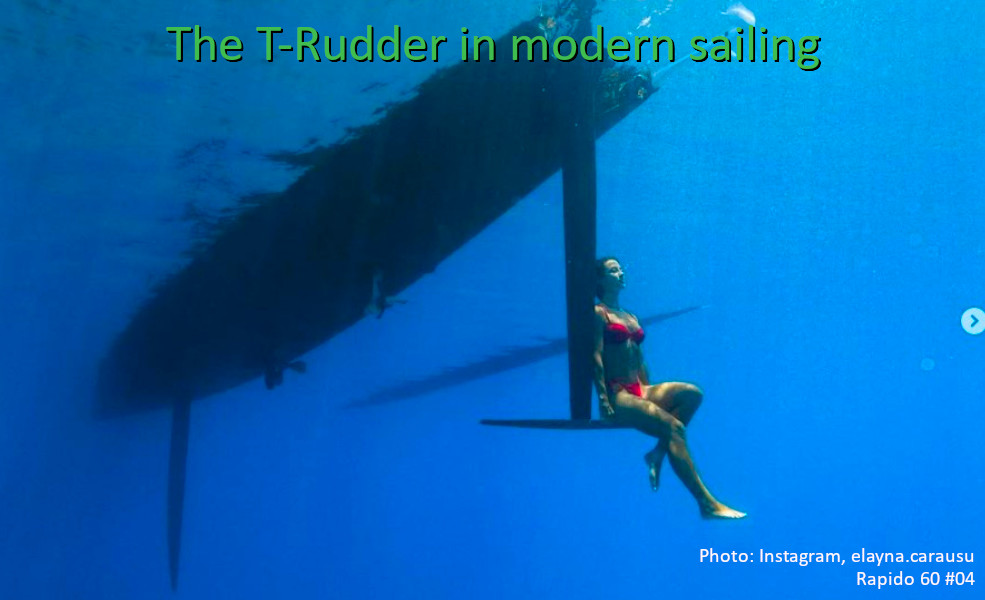
When sailing at speeds of 10 knots or higher, managing a trimaran’s dynamic trim becomes increasingly critical. The addition of a T-rudder provides a practical way to manage these forces, offering distinct advantages in handling and efficiency:
- Managing Dynamic Trim (Pitch Angle)
The T-rudder allows for fine-tuning of the boat’s pitch angle to optimize hull and float (ama) hydrodynamics. For boats equipped with C-foils, this directly influences their angle of attack. By altering the lift profile of the foils, the crew can better balance the boat across varying sea states and wind angles. - Damping Pitch Motion (A Steadier Platform)
By acting as a horizontal stabilizer to reduce up-and-down pitching in a seaway, the T-rudder helps maintain a more consistent flow of water over the foils and air across the sails. Minimizing these sudden changes in flow reduces transient drag, leading to better average speeds and more consistent tracking.

Handling and Control Benefits in Heavy Air
Beyond optimizing performance numbers, the horizontal element of a T-rudder provides a valuable margin of safety during high-load maneuvers, such as bearing away in strong winds or broad-reaching in a significant swell.
- Mitigating the Tendency to Bow-Dive: The vertical lift or downforce generated by the T-foil helps keep the bows from digging in or “stuffing” when accelerating down the face of a wave.
- Maintaining Steering Authority: The design helps keep the rudder blade effectively submerged and loaded, reducing the risk of ventilation and maintaining reliable helm control when the boat is pressed hard.
While a T-rudder cannot replace sound seamanship, it effectively broadens the boat’s control window, making the platform more predictable and manageable when conditions worsen.
Engineering and Construction
To handle the high hydrodynamic loads generated at speed, all Rapido T-rudders, alongside other high-load structures like masts, C-foils, daggerboards, and beams, are engineered by Morrelli & Melvin.
These components are built in-house by Triac Composites using prepreg carbon fiber and cured under pressure in an autoclave to ensure structural integrity and strict weight management.
Banner Photo: See the Original Image on Instagram
- View the T-rudder configuration via teh Instagram account of elayna.carausu (Featuring Rapido 60 #04, La Vagabonde III)