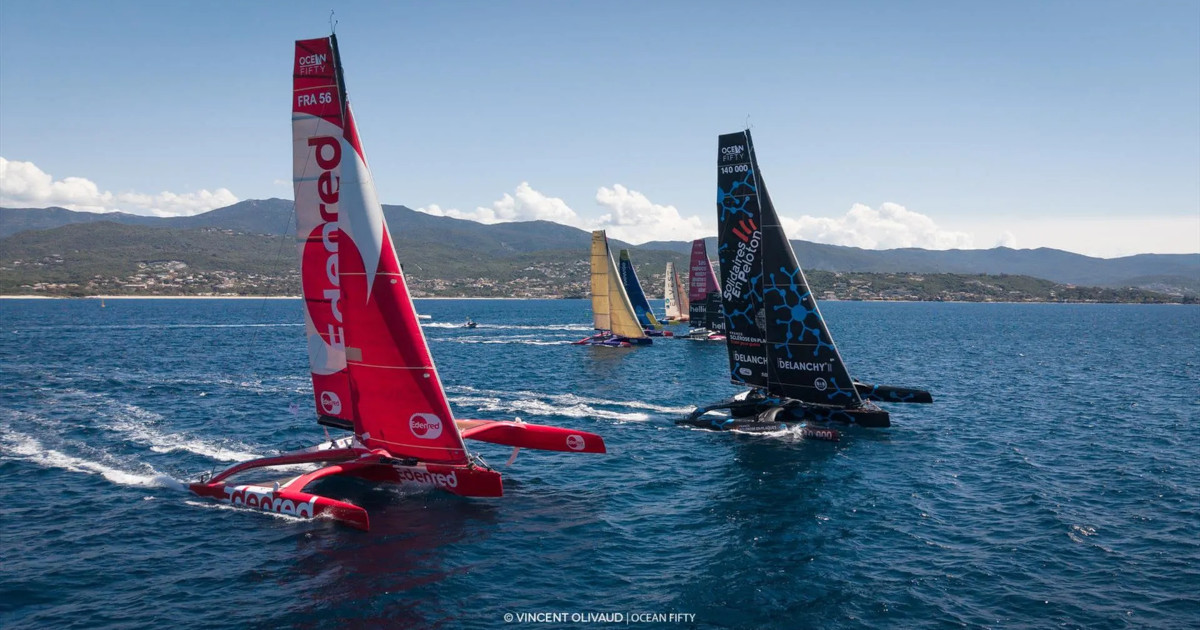
For more than half a century, La Solitaire du Figaro has occupied a unique position in offshore sailing. As one of the world’s most demanding solo circuits, it has launched the careers of many of France’s finest ocean racing sailors. Throughout its 56-year history, one characteristic remained unchanged: competitors raced in one-design monohulls.
That changes in 2028.
Following a joint decision by Groupe Figaro and race organizer OC Sport Pen Duick, the fleet will move to Ocean Fifty trimarans, ending more than five decades of monohull tradition and opening what organizers describe as “a new chapter in the history of offshore racing.”
Crucially, the organizers emphasized that adapting the fleet is about securing the race’s future while safeguarding its history, tradition, and ongoing relevance. As reported by Sail-World.com, OC Sport Pen Duick president Hervé Favre noted:
“As its organizer, our foremost responsibility is to prepare it for the future. It is our role to ensure that, for decades to come, the event continues to be the premier annual event in French offshore racing while remaining true to the sporting principles that have built its reputation for more than fifty years.”
That tension between tradition and evolution is precisely what makes the announcement so significant. Changes of this magnitude are rarely driven by novelty alone; they reflect where experienced sailors, naval architects, and institutions believe offshore sailing is heading.
Looking Beyond Speed
The obvious explanation for the shift is performance. Ocean Fifty trimarans are capable of speeds well beyond those of the monohulls they replace. Yet the organizers themselves place relatively little emphasis on outright velocity.
Instead, their public commentary focuses on building upon the maturity of the Ocean Fifty class, increasing appeal to competitors and spectators, and opening options for more ambitious offshore courses.
Modern offshore trimarans have developed a distinct combination of characteristics that extend well beyond professional racing: high average passage speeds, excellent directional stability, minimal heel to reduce crew fatigue, and efficient sail plans manageable by small crews or, in the case of the Figaro, a single solo sailor.
These traits matter in elite competition, but they matter equally to sailors crossing oceans with family and friends. The operational objectives differ, but many of the underlying engineering principles are remarkably similar.
Offshore racing has long functioned as sailing’s development laboratory. Carbon masts, composite engineering, advanced sail cloth, integrated autopilots, and structural load modeling all reached cruising yachts after proving themselves in competition. Yet in terms of platform selection, demanding private owners sailing 50- and 60-foot trimarans were among the first to demonstrate that this scale offers the ideal balance of speed, safety, and short-handed manageability for long ocean passages.
Seen in that context, La Solitaire du Figaro’s move to 50-foot trimarans feels less like a sudden revolution and more like an institutional validation of where modern offshore sailing has already been heading.
A Shared Offshore Design Philosophy
Rapido occupies a neighboring corner of that same multihull landscape. Its range of 40, 50, 53, 60, and 63-foot trimarans was never intended to compete on the Ocean Fifty circuit; they are designed for owner-operated offshore cruising rather than elite offshore racing. Every model, however, is engineered and constructed to CE Category A (Ocean) standards which is the European Union’s highest threshold for recreational blue-water sailing.
The missions are distinct: Ocean Fifty trimarans are stripped-out machines built for professional grand prix racing; Rapido’s 50 and its stablemates are built for fast, comfortable ocean passages – while remaining more than capable of picking up silverware in offshore rallies and regattas. Both, however, draw upon the exact same advances in naval architecture, composite engineering, and sail design.
That connection was detailed in a feature published by Sail Magazine, examining how Rapido’s naval architects, Morrelli & Melvin, apply tools developed at the highest levels of multihull competition to performance cruising trimarans.
Morrelli & Melvin have spent decades at the forefront of multihull development, including design involvement in five America’s Cup campaigns such as BMW Oracle Racing and Emirates Team New Zealand. Their brief for the Rapido program was not to create stripped-out race boats, but to apply elite analytical tools to produce cruising yachts that are lighter, stronger, and simpler to manage shorthanded.
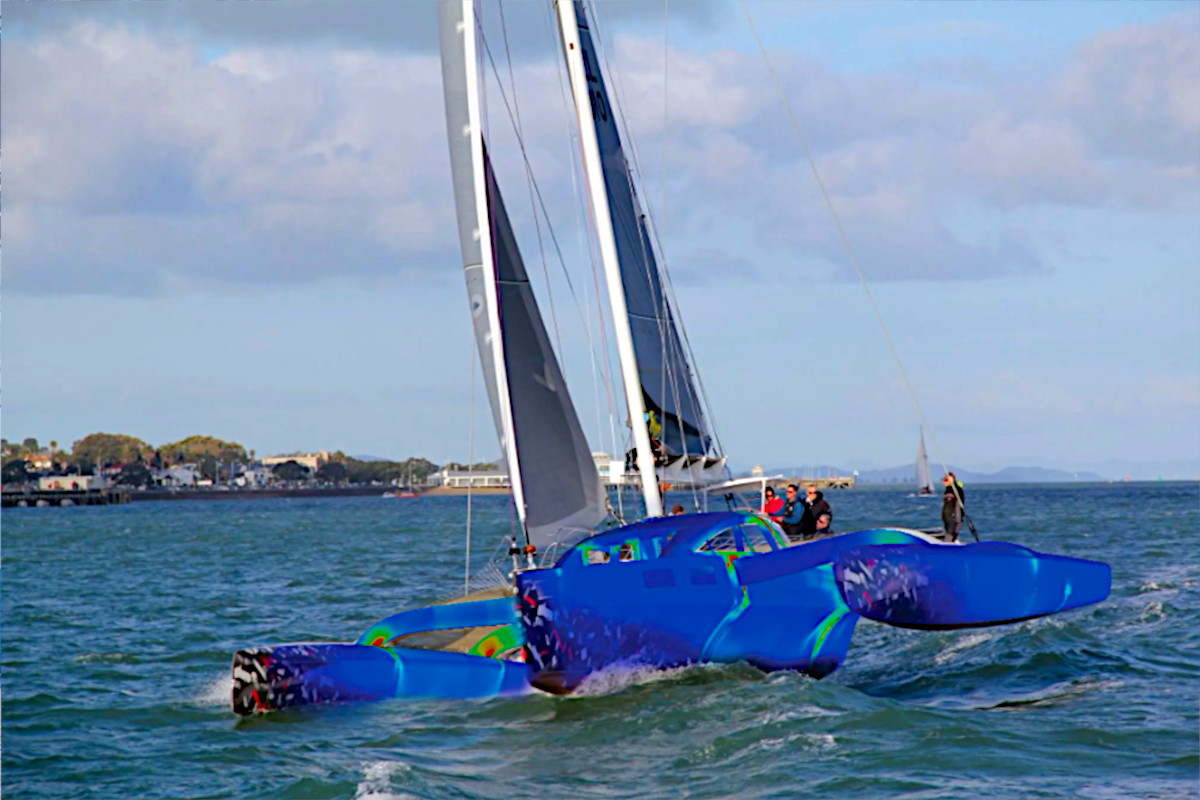
As partner Erik Berzins explained, the design process integrates Computational Fluid Dynamics (CFD), Finite Element Analysis (FEA), Fluid-Structure Interaction (FSI), and velocity prediction modeling using GOMBOC, the simulation software originally developed for Emirates Team New Zealand.
Berzins describes this stage of design as “making it real.” Ideas become engineering, assumptions become calculations, and experience becomes measurable data. None of these technologies are unique to Rapido, nor to Ocean Fifty trimarans. They simply represent the standard by which modern offshore multihulls are conceived, illustrating the close relationship between elite offshore racing and modern performance cruising.
When Engineering Meets the Ocean
Engineering, of course, only matters if it translates into practical capability at sea. That principle was highlighted in a technical profile published by North Sails, featuring Dougall and Jaz Love aboard their Rapido 60, Romanza.
As a supplier to many of the world’s leading offshore and America’s Cup campaigns, North Sails also builds inventories for a number of Rapido owners. Analyzing the loads their sails routinely manage, Dougall Love noted:
“I am constantly amazed at the loads they can handle, particularly upwind. Our righting moment is around 60 tonne-metres, and the sails can be fully loaded but do not stretch or strain.”
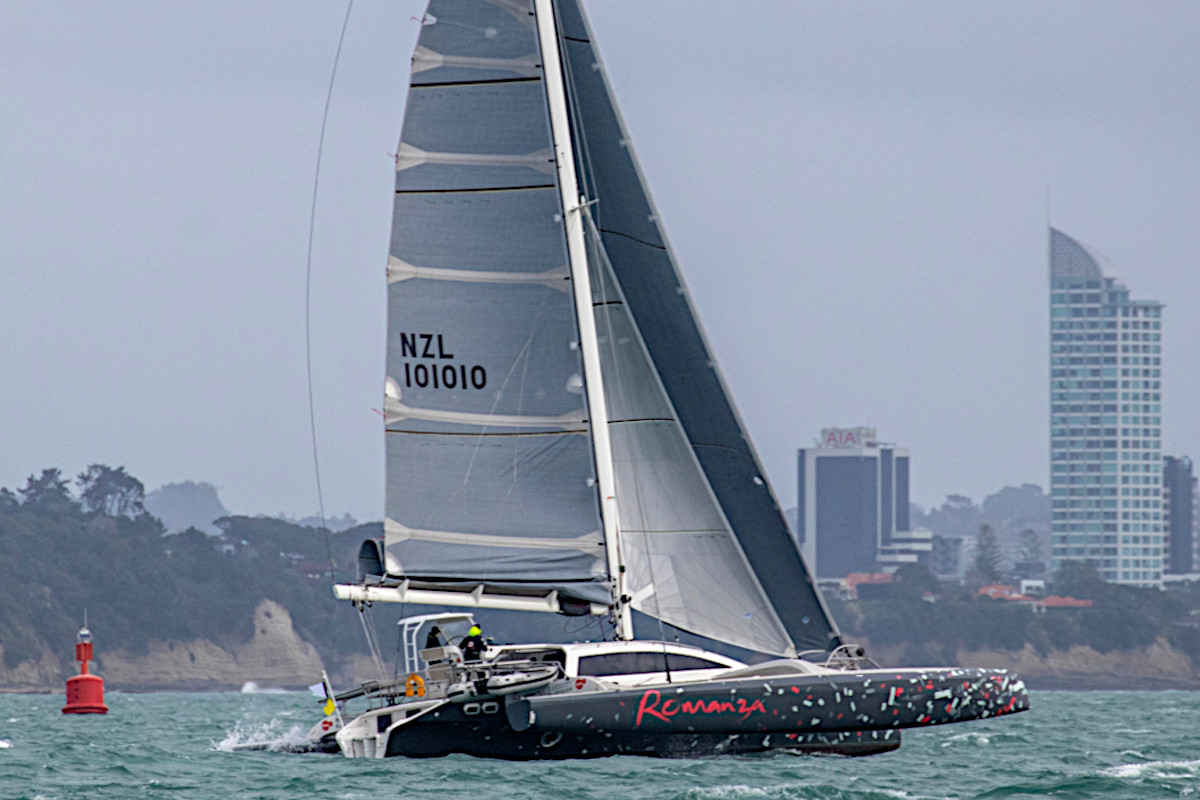
Righting moment is more than resistance to heel. It is the physical force that allows a yacht to convert wind energy into forward motion rather than sideways drift. The consequence is enormous load throughout the rig, which explains why sail technology developed for elite offshore racing is equally valuable aboard serious cruising trimarans.
For long passages, 24-hour averages matter far more than occasional peak speeds. As Dougall Love noted:
“On some of our trans-Tasman crossings, we’ve had 24-hour averages approaching 300 miles—not bad for a cruising boat.”
Higher daily runs shorten passage times, expand weather-routing options, and reduce overall exposure to severe weather systems.
“She doesn’t take much to go fast, although our concept of ‘fast’ has changed significantly since our pre-Rapido days.”
The objective is not simply high-speed sailing, but operational efficiency – whether that means continuing under sail when others might start the engine, or simply shortening passage times and reducing crew fatigue.
That efficiency translates to racing as easily as passage-making. Romanza demonstrated the balance by claiming line honours and overall corrected time (PHRF) in the 130nm Auckland-Tauranga Centennial Race, finishing ahead of a fully crewed Volvo 65. After crossing the finish line, the crew sat down to slow-cooked lamb shanks that had been simmering in the galley during the race.
Jaz Love offered a practical perspective on structural integrity. Recalling a seven-week double-handed cruise around New Zealand during which Romanza encountered severe gusts up to 62 knots, she remarked: “I feel our safety and comfort level has taken a stride since that experience. Nothing failed – and that included our confidence.”
Dougall highlighted the handling dynamics that make those conditions manageable: “Reefing the main is simple, and the boat will still make way with haste”. With primary sail controls led aft, integrated autopilot hardware, and straightforward reefing geometry, the system does not demand a crew of professional racers to operate safely.
That same structural confidence was recently taken to a geographical extreme by the Rapido 53XS Picomole. After winning the multihull division of the 2025 Atlantic Rally for Cruisers (ARC) by several days, Picomole then became the first cruising trimaran to voyage to Antarctica. On the return trip across the notorious Drake Passage, owner Aldo Fumagalli logged a remarkably swift crossing: 420 nautical miles from Deception Island to Cape Horn in 42 hours and 39 minutes which is an average speed of nearly 10 knots in some of the world’s most demanding waters.
Whether crossing the Drake, winning ocean rallies, or cooking dinner at 15 knots, the underlying engineering delivers performance without requiring austerity.

A Monohull Racer’s Independent Calculation
A similar evaluation process led a veteran Class 40 skipper to place an order for Rapido 50 Hull #04.
Having campaigned a shorthanded monohull offshore for years, his decision to transition to a trimaran was driven by clear priorities: preserving high passage speeds and responsive handling without “having to live with a heel of 15 to 20 degrees for days on end.”
In his assessment, a performance trimaran provided the speed, pointing ability, and structural safety of his racing background without the physical toll of constant heel or the performance compromises of a heavy cruising catamaran.
Where the Currents Converge
None of these developments depend directly upon the others. The organizers of La Solitaire du Figaro were addressing the future of a professional race. North Sails was documenting owner feedback on sail performance. Sail Magazine was reviewing multihull engineering methodologies. A Class 40 sailor was selecting a blue-water cruising boat for his family.
Yet each addresses the same central questions: How do offshore yachts become more efficient? How can they remain simple to handle without sacrificing performance? How can we reduce crew fatigue while expanding operational capability?
In an interview with Boating NZ back in 2021, Rapido co-founder Paul Koch summarized the company’s founding brief:
“The whole Rapido trimaran concept came about because we felt the world needed a larger, roomier cruising trimaran with good living space that delivered great performance.”
At the time, that statement reflected one builder’s view of where offshore cruising could evolve. Today, as one of offshore sailing’s most established institutions aligns its future with 50-foot trimarans, those same principles are becoming further embedded across designers, sailmakers, and race organizers alike.
Whether La Solitaire du Figaro’s transition marks a sudden revolution or merely confirms a trend long underway, what seems certain is that the collective pool of ocean-going multihull data, refinement, and passage analysis is about to expand significantly.
Editor’s Note:
Since the publication of the North Sails article, Rapido has brought rig manufacturing fully in-house. All models across the range now feature custom, full-carbon, rotating, spreaderless wing masts and booms – designed and engineered specifically for the Rapido fleet by Morrelli & Melvin. They are built at our facility in Vietnam, Triac Composites.
Credits and sources
- Main photo, Ocean Fiftys, La Solitaire du Figaro © Vincent Olivaud. Taken from sail-world.com
- La Solitaire du Figaro opens a new chapter in 2028, 17 July 2026, Sail-World.com
- The Solitaire du Figaro Goes Multihull!, Emmanuel van Deth, Multicoques Hull, 17 July 2026
- Cutting-edge Technology for Multihull Design, Zuzana Prochazka, Sail Magazine, 23 March, 2022
- Rapido 60, Romanza: the Ultimate Racer Cruiser, North Sails Website
- Crossing the Drake. Picomole reaches Antarctica, Rapido Trimarans’ website, 8 February 2026
- From Class 40 Racing to World Cruising. Why this veteran chose a Rapido 50, Rapido Trimarans website, 17 July 2026
- Rapido 50 Review, Boating New Zealand, John Eichelsheim, 12 October 2021