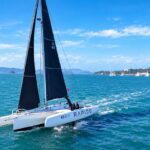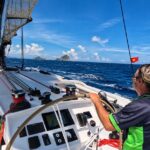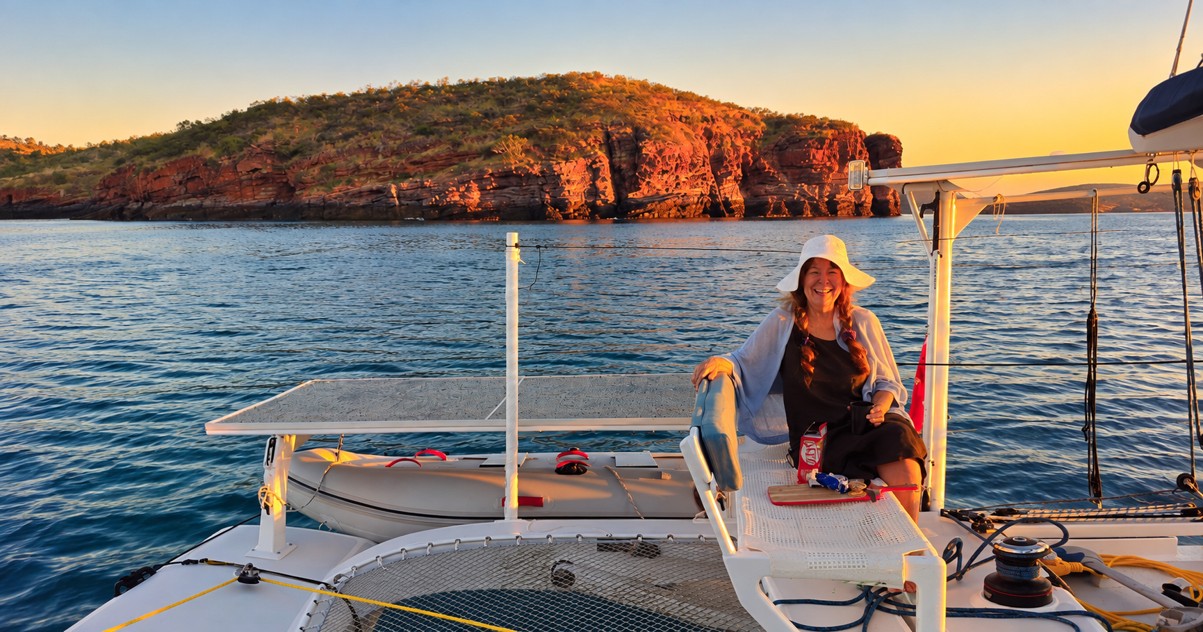
From Vietnam through Indonesia to Australia’s remote Kimberley coast and beyond, Rapido 40 Lightning (#014) is taking owner Alan Noble and his wife, Merri, on an extraordinary journey. Alan’s Lightning Sailing blog captures the remarkable places, practical challenges and freedom of exploring the world aboard an all-electric performance trimaran. Photo Lightning Sailing.
A different perspective on the world
Imagine cruising into a remote river in Australia’s Kimberley wilderness, surrounded by towering sandstone cliffs, waterfalls and ancient landscapes. You have the place almost entirely to yourself.
Then, the following morning, fifteen rigid inflatable boats sweep past, carrying around 180 passengers from the 157-metre cruise ship Silver Cloud, waiting offshore.
That was one of many memorable moments for Alan Noble and his wife, Merri, exploring the Kimberley aboard their new Rapido 40, Lightning.
They had enjoyed the spectacular King George River and its waterfalls in solitude the previous day. Now visitors were arriving en masse for their own brief experience of the same remarkable place.
Having the freedom to explore these destinations independently, at their own pace, is one of the wonderful possibilities that a capable cruising yacht can offer.
From the Frenzy of Saigon to the Stillness of the Kimberley
Lightning, Rapido 40 Hull #014, was launched into the Saigon River on 23 March 2026.
Built by Triac Composites in Vietnam, she is an all-carbon-fibre, high-performance folding trimaran, designed for fast offshore passages and comfortable cruising.
After addressing the most pressing commissioning issues, Alan and his delivery crew departed Saigon five days later, heading through Indonesia via Batam, Lombok, the Komodo region and Kupang before crossing the Timor Sea to Darwin.
From Darwin, Alan and Merri continued along Australia’s Kimberley coast to Broome and onward to Port Hedland.
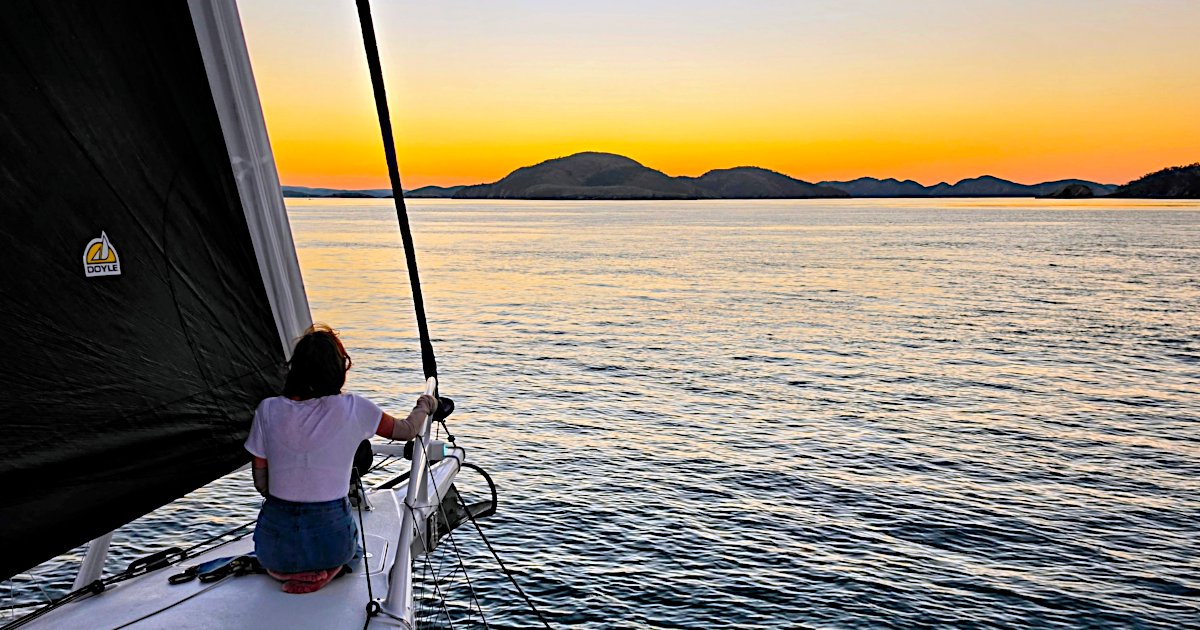
Along the way came whale sharks, Komodo dragons, crocodiles, remote anchorages, spectacular waterfalls and ancient Aboriginal rock art.
There were moments of uncertainty, too, including one that later became a humorous refrain:
“Is that a rock or a croc?” asked Merri while preparing the dinghy at Wary Bay. Alan concluded that, this time, it was a rock. Nevertheless, mindful of the crocodiles inhabiting these waters, he took a boat hook as a precaution.
Electric cruising, sailing performance and the freedom to choose
Lightning is Rapido’s third all-electric performance sailing trimaran, but the first equipped with twin retractable ePropulsion X12 electric outboard motors.
For owner Alan Noble, an engineer, writer, technology entrepreneur and ocean lover who founded the Australian non-profit AusOcean in 2017, the technology is naturally a subject of considerable interest.
His technical background adds a fascinating dimension to the blog, particularly his observations about the practical realities of electric cruising.
Alan explains how Lightning’s lightweight, efficient hulls allow her to maintain approximately five knots in flat water using just 2kW of propulsion power – roughly what an electric kettle consumes.
But with 46kWh of propulsion battery capacity, that represents only 23 hours of operation at 2kW without recharging.
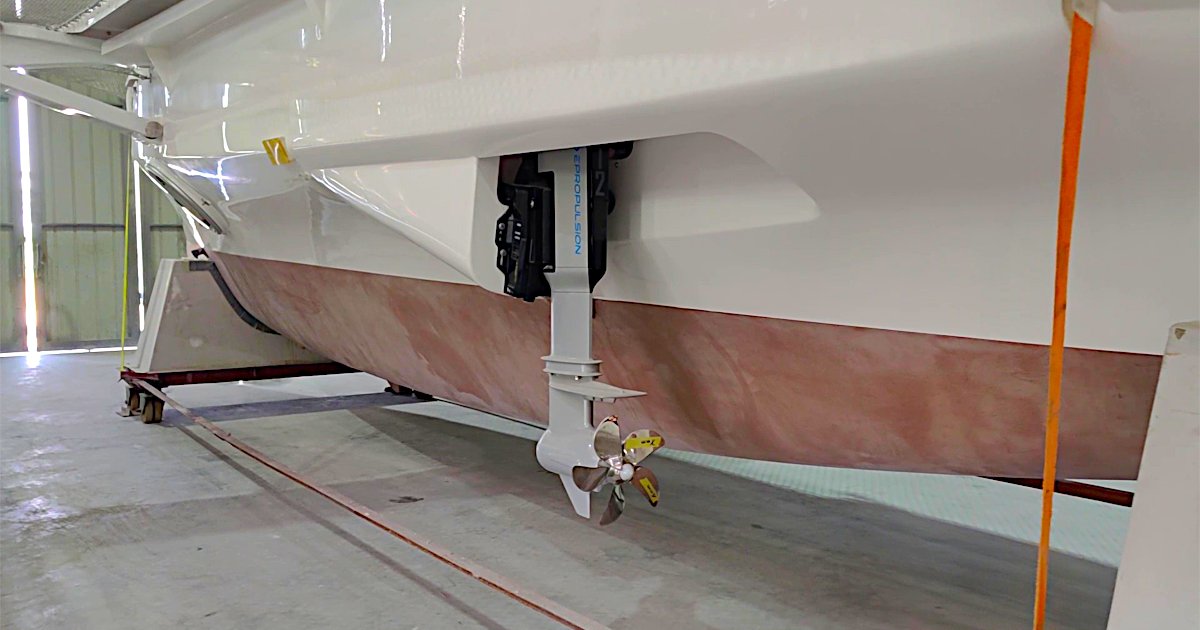
Solar panels and hydrogeneration help replenish the batteries, but wind remains the preferred source of propulsion. Unfortunately, it has been in relatively short supply throughout much of the voyage.
During the Indonesian delivery passages, Alan and his crews relied extensively on electric propulsion, including three days of continuous motoring across the Java Sea. Their portable Honda generator, affectionately named “Honda-San”, ran much of the time.
At comparable speeds, Alan reports that Lightning uses approximately half the fuel per hour of his previous catamaran, the 38-foot Arriba. That’s particularly impressive given Lightning is two feet longer – and a practical demonstration of the efficiency of her lightweight, slender hulls.
And when the wind arrived, the sailing brought its own rewards.
In 19 knots of wind, Lightning made 5.6 knots under jib alone. Alan admitted he was “feeling lazy” and dispensed with the mainsail. They completed the 51-nautical-mile passage averaging 6.1 knots.
On another morning, a 16-knot easterly had Lightning sailing towards Broome at 7.5 knots.
A longer passage of 137 nautical miles averaged 6.3 knots in winds seldom exceeding 10 knots. Anticipating uncomfortable wind-against-tide conditions, Alan weighed anchor at the decidedly unsociable hour of 2:44 a.m. to take advantage of the westward flood tide.
It’s easy to assume that a high-performance yacht demands to be sailed fast. Yet greater capability gives the skipper more choices, not fewer. Alan could sail under jib alone, take things easily or make the most of favourable conditions.
Performance isn’t simply about speed. It’s also the freedom to choose how you sail.
Resourcefulness comes with the territory
Cruising in remote places isn’t always straightforward. There are unfamiliar ports, bureaucratic formalities, unpredictable currents, poorly charted reefs and difficulties finding even basic supplies.
And Lightning is a new boat. Like many new boats, she has experienced teething problems.
Alan doesn’t shy away from discussing them.
When the anchor windlass failed at Rinca Island, the crew improvised a system using an electric winch to retrieve the chain. Alan traced the fault to loose connections at the solenoid control unit.
When the Starlink Mini overheated in its poorly ventilated deck mount, Alan purchased a replacement and drilled ventilation holes to prevent the problem recurring.
Other challenges were simply part of cruising.
At Broome, a torn reacher needed repair. With no local sailmaker available, North West Trim and Shade agreed to help. Alan and Merri transported the sail six kilometres using their folding bicycles and beach wagon.
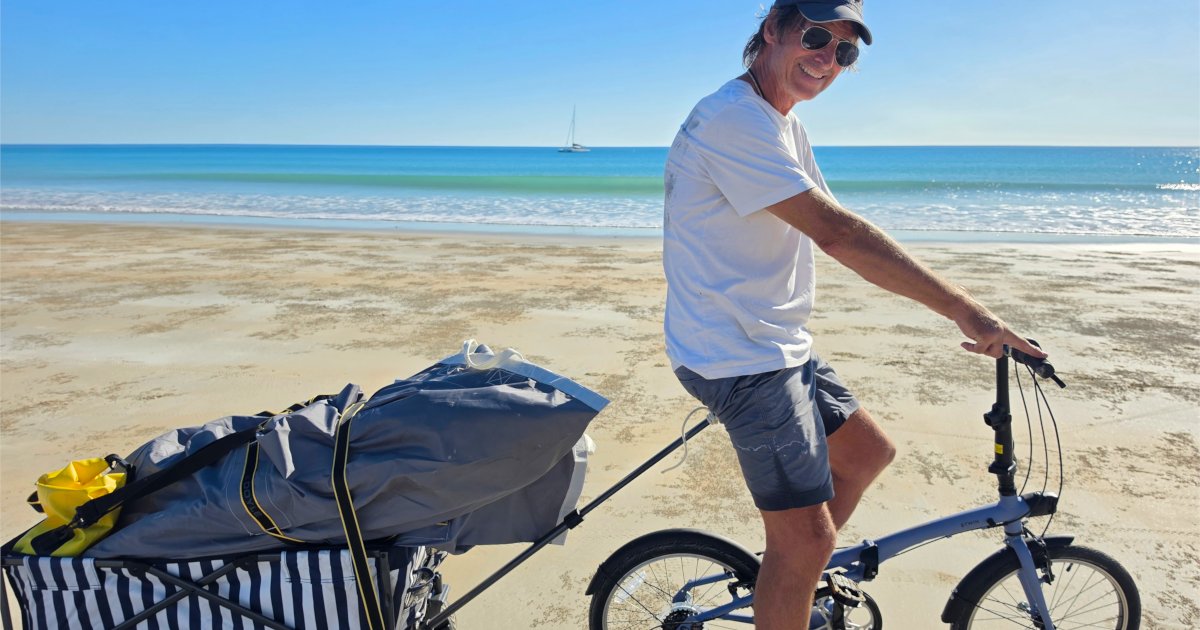
Sometimes that’s what resourcefulness looks like.
At Port Hedland, Alan reported that Lightning’s port electric motor had snagged a rope, apparently causing an internal failure. ePropulsion requested that the 50kg motor be sent to Melbourne for diagnosis and repair.
What makes Alan’s accounts particularly worthwhile is the context.
Problems are neither glossed over nor allowed to overshadow the wider experience. Alan describes the circumstances, decisions and solutions, where known, as part of the broader journey.
For Rapido, these accounts are valuable too. Owners operating their boats in demanding conditions reveal what works, what doesn’t and what can be improved. There will always be lessons to learn.
When the boat makes the difference
Some of Alan’s observations demonstrate practical advantages of the Rapido design.
Entering the shallow King George River, Lightning briefly grounded but floated free thanks to her transom-mounted kickback rudder. Alan then raised the rudder by 90cm, reducing her draft to just 90cm and allowing them to continue upriver.
At Port Hedland, the folding system proved equally useful.
Alan folded Lightning’s starboard float to fit her allocated berth at Spoilbank Marina. He explains that folding was a major selling point when choosing the boat: without it, neither the Darwin nor Port Hedland marina berths would have been possible.
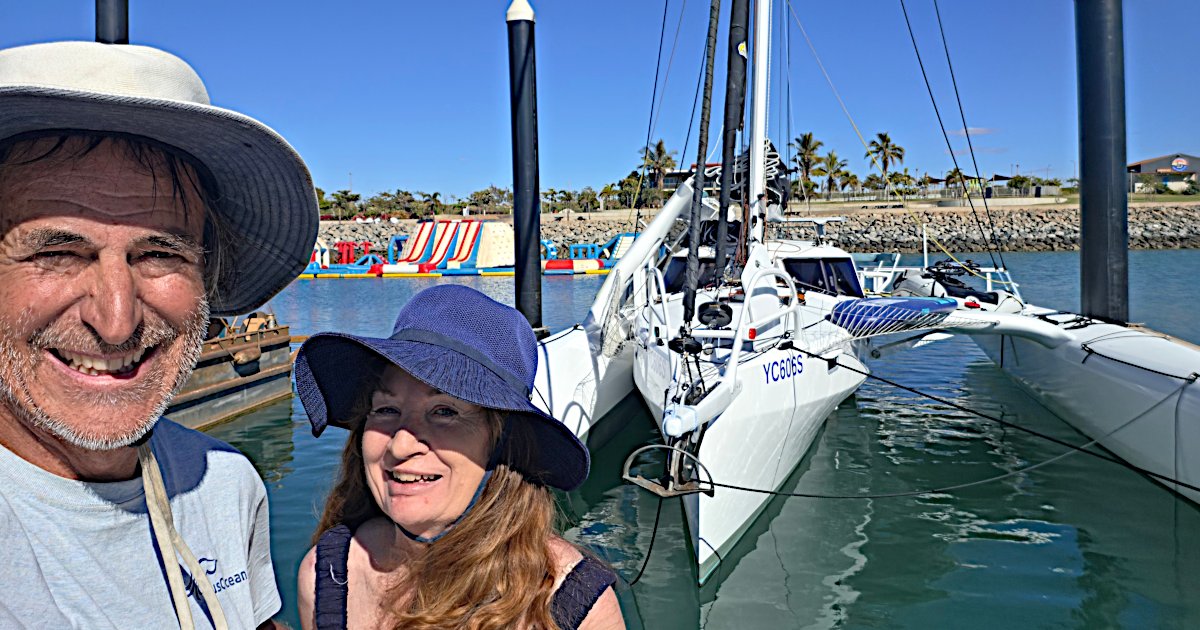
And there are benefits beyond accessibility and speed.
Following an uncomfortable night near Amphinome Shoals, Alan described Lightning’s narrow hulls slicing through the remaining lumpy seas for a remarkably smooth ride. In his assessment, considerably smoother than his previous catamaran, Arriba, would have delivered in similar conditions.
These are practical observations from an owner using his boat in real conditions, rather than performance claims made in isolation.
The freedom to explore
Ultimately, Alan’s blog is about much more than the boat.
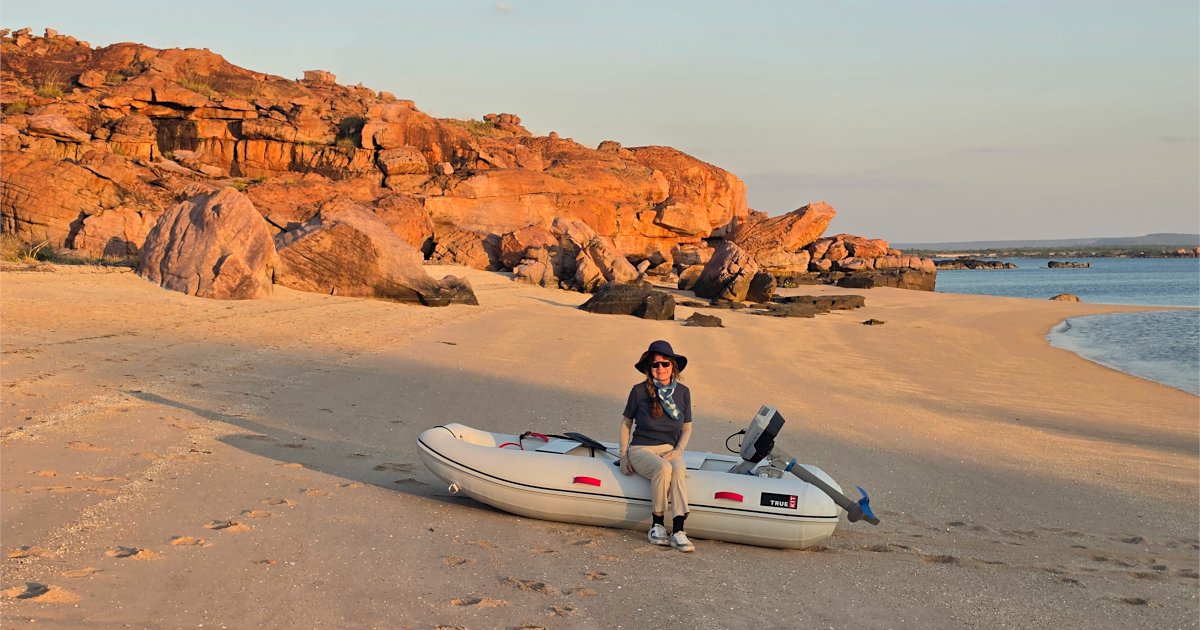
It’s about discovering remarkable places, experiencing different cultures and histories, encountering wildlife and venturing beyond the usual tourist routes. It’s also about the surprises, frustrations and practical challenges that come with that freedom.
And then there’s the sailing itself – a constant game of chess with the wind, currents and tides.
Sometimes Lightning is the means of reaching an extraordinary destination. Other times, when the wind fills the sails and the boat comes alive, the journey becomes the highlight.
For Alan and Merri, Lightning is opening up a remarkable world of possibilities. Not everything will go according to plan. But that’s part of exploring the world under sail – and there are still extraordinary places, unforgettable encounters and new horizons ahead.
And that’s what makes their story so interesting to follow.
From Port Hedland, Alan and Merri plan to continue south along Australia’s western coastline towards South Australia. And after that? Who knows where Lightning might take them?
We encourage anyone interested in sailing, exploration and life aboard a cruising trimaran to follow the journey on Alan’s Lightning Sailing blog.
His original articles include detailed passage accounts, technical observations, photographs, local history and practical lessons we’ve only touched upon here.
The adventure continues. Follow along.