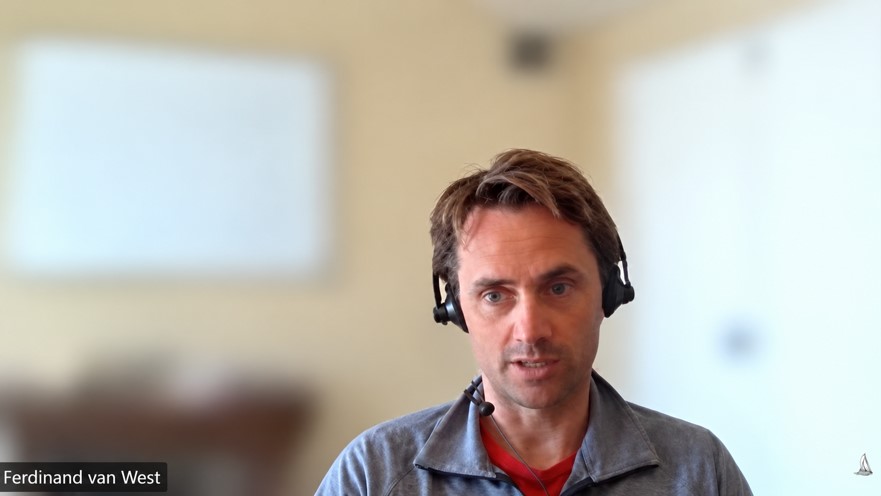
[Screenshot Caption: Ferdinand van West during his interview with Diane Selkirk of Catamaran Site.]
What distinguishes modern cruising trimarans from catamarans? Ferdinand van West of Morrelli & Melvin explores sailing performance, accommodation and the trade-offs involved in choosing between them.
In an interview with Diane Selkirk of Catamaran Site, Ferdinand van West offers an informed perspective on modern performance multihulls.
As a naval architect with Morrelli & Melvin, his experience includes Rapido Trimarans, Gunboat and HH catamarans, Nacra racing catamarans and America’s Cup projects.
This breadth of experience makes the interview particularly interesting. Rather than presenting trimarans or catamarans as universally superior, Ferdinand explores their different characteristics and how design priorities influence the sailing experience.
Ferdinand van West speaks with Diane Selkirk of Catamaran Site.
The Sailing Experience: Why Trimarans Feel Different
One of the defining attractions of a performance cruising trimaran is the responsiveness and excitement of sailing it.
Ferdinand describes trimarans as “a little bit more dynamic”. As the windward float lifts clear of the water, the boat can accelerate quickly, manoeuvre responsively and deliver a more engaging sailing experience.
He regards this as a particular strength of the Rapido concept, where lightweight construction, hull design, foils and sail configuration all contribute to performance.
Ferdinand also draws on his experience with high-performance HH and Gunboat catamarans, recognising the impressive capabilities of these designs. Interestingly, he notes that the Rapido 60 achieves high performance despite having a less powerful sail plan than some of these catamarans.
The result is a distinctive sailing experience – one that combines the advantages of multihull sailing with the acceleration, responsiveness and sensation of movement that many experienced sailors particularly enjoy.
Foils, Weight and Performance
Ferdinand explains that trimarans give designers considerable flexibility in the arrangement of their daggerboards, foils and rudders.
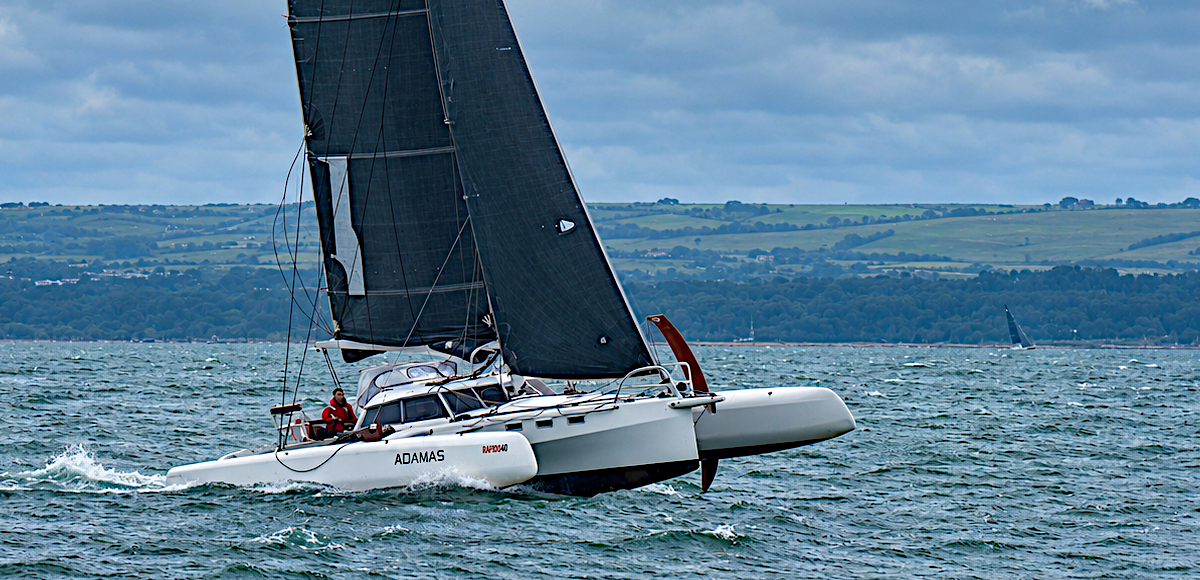
The Rapido 60, for example, has a centre daggerboard and a single rudder, while the Rapido 40 takes a different approach, with curved C-foils in its floats and no centreboard.
As Ferdinand explains, the curved foils allow designers to use different foil shapes and profiles to generate additional hydrodynamic lift, enhancing sailing performance.
He also highlights the Rapido 60’s relatively low weight as another important contributor to its performance.
Together, these design choices demonstrate how foil configuration, hull design and lightweight construction can combine to deliver the responsiveness and performance that distinguish modern cruising trimarans.
Who Is a Rapido Designed For?
Rapido began with Paul Koch’s philosophy of boats designed by sailors, built by sailors, for sailors.
Ferdinand describes the original Rapido 60 concept as almost a disruptor – a larger performance cruising trimaran that was markedly different from what the market then offered. It took time for the concept to develop and attract interest, but by the time of the interview, Ferdinand was seeing growing enthusiasm, particularly for the Rapido 40.
That interest comes from both catamaran owners looking for a different sailing experience and monohull sailors attracted to multihulls but unwilling to give up the responsiveness and excitement they enjoy under sail.
Accommodation: Where Catamarans Have an Advantage
Ferdinand readily acknowledges that catamarans have an advantage when it comes to accommodating multiple cabins and bathrooms. A four-cabin, four-bathroom layout, for example, is more difficult to achieve aboard a Rapido 60.
But cabin numbers don’t tell the whole story.
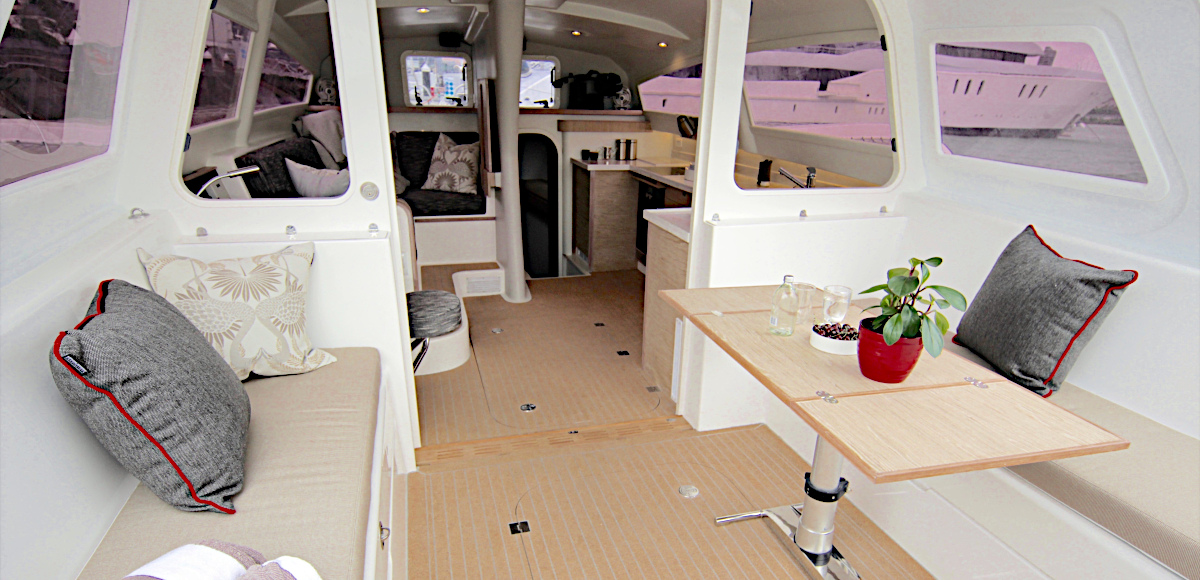
Ferdinand recalls that the Rapido 60’s living space was calculated to be comparable with that of a similarly sized catamaran. He particularly highlights the saloon, whose generous proportions often surprise visitors seeing the boat for the first time.
For owners seeking two or three cabins rather than maximising the number of separate accommodation units, he considers the Rapido 60 competitive in terms of liveability.
One particularly innovative feature is the continuous walkthrough along the main hull. Ferdinand explains how the major structural beams were integrated into the bulkheads, rather than passing through the interior as they do in many racing trimarans.
The Practical Compromises of Trimaran Ownership
Ferdinand also highlights the Rapido 60’s generous and easily accessible storage spaces. But having the room doesn’t mean it should all be filled. Additional weight affects sailing performance, and as Ferdinand cautions, “it’s still weight sensitive.”
That gives owners the flexibility to decide what to carry, particularly when provisioning for an extended cruise, while balancing comfort and supplies against sailing performance.
Ferdinand acknowledges that beam can present a practical challenge for trimaran owners, particularly when finding a suitable marina berth. An end-tie berth may be preferable where conventional slips cannot accommodate the boat’s width.
He points out that the Rapido 50 and 40 all have folding arrangements, although folding and unfolding still require some effort. He also notes that marinas have become more accommodating of larger multihulls and that hauling out folding trimarans is now relatively straightforward.
When considering whether a trimaran or catamaran is the better choice, Ferdinand places considerable emphasis on the owner’s priorities: budget, cruising or racing ambitions, and whether they intend to sail independently or with a professional captain.
Ultimately, the choice depends on how the owner intends to use the boat and which characteristics matter most to them.
The Continuing Evolution of Multihull Design
Looking ahead, Ferdinand sees exciting developments in foil technology, lightweight construction, more efficient hull designs and optimised rigs.
He describes how these advances are improving performance, including in cruising boats, as designers continue to explore new ways of generating lift, reducing weight and making better use of available sail power.
For Rapido, it reinforces the thinking behind the original concept: combining innovative design with advanced technology to create increasingly capable performance cruising trimarans.
A Balanced Perspective on Multihull Design
Ferdinand’s extensive experience designing both trimarans and catamarans gives him an appreciation of their respective strengths. Rather than declaring one superior, he recognises the different characteristics, advantages and compromises of each.
It’s this balanced perspective that makes the interview particularly valuable to sailors considering a performance cruising multihull.
Watch the full interview above, or read Diane Selkirk’s original interview on Catamaran Site.
Our thanks to Diane Selkirk, Ferdinand van West and Catamaran Site for sharing the discussion.