

Introduction
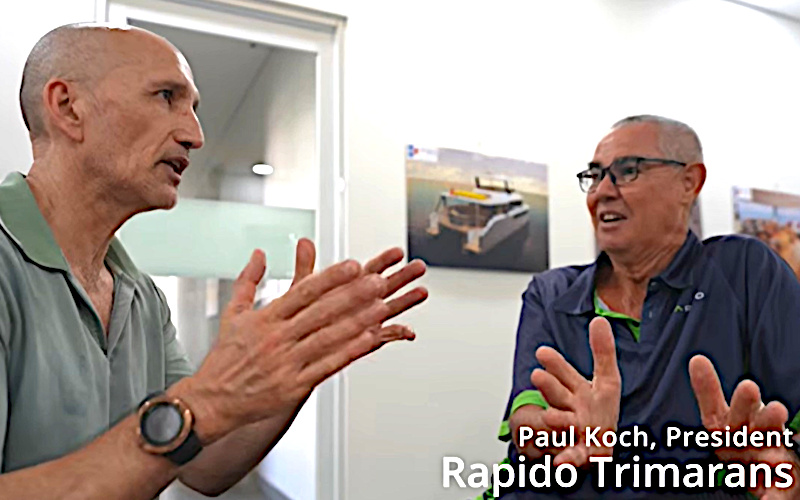
In this in-depth interview, renowned travel writer and adventurer Francis Tapon sits down with Paul Koch to discuss the real-world advantages of trimarans over monohulls and catamarans.
From performance and safety to electric propulsion and the future of sustainable sailing, this conversation offers valuable insight into why high-performance trimarans are gaining attention among serious sailors worldwide.
Click on the video below to watch the full interview. Beneath it, you’ll find a concise summary of the key topics covered. Click on any timestamp to jump directly to the section of the interview that provides a detailed answer to that question.
Watch the Full Interview
Trimaran vs Monohull: What’s the Advantage? (00:00)
Francis Tapon:
What are some of the advantages of trimarans versus a monohull?
Paul Koch:
The real advantage in the early days was trailability. Trimarans worked much better as trailerable boats than catamarans. You could have a trimaran that was 20 feet wide, fold it down to around 8 feet, and tow it on a trailer.
That’s why some of the early popular trimarans, like Corsair models, became so well known.
Folding Systems & Practical Use (00:28)
Francis Tapon:
And you’ve kept that folding ability on much larger boats?
Paul Koch:
Yes. On the Rapido 40 and Rapido 50, we still fold the floats (amas) for marina berthing. That’s another big advantage of a folding trimaran.
Performance: Why Trimarans Sail Better (00:49)
Francis Tapon:
How do they compare in performance?
Paul Koch:
Trimarans are significantly better upwind than catamarans. They tack better and behave more like a monohull in that sense, but with a stable platform.
We typically point about 10 degrees higher and sail faster than any catamaran on the market. Bar none.
Stability & Handling (01:32)
Paul Koch:
A trimaran essentially rocks from one side to the other like a monohull, but it’s stabilized by the floats. That gives it better handling and efficiency.
Comfort at Sea (01:58)
Paul Koch:
Another major advantage is comfort. Trimarans have a much smoother ride in rough or choppy conditions, especially upwind.
Safety & “Unsinkable” Design (02:12)
Francis Tapon:
One attraction is that trimarans are effectively unsinkable.
Paul Koch:
There’s a huge amount of reserve buoyancy. Each float has multiple watertight compartments, and each one can support the weight of the boat.
Even if the main hull filled with water, the boat would still float.
We also design our boats with no penetrations below the waterline in bulkheads. The main hull is divided into watertight sections as well.
What Happens If a Catamaran Capsizes? (03:25)
Francis Tapon:
What about catamarans?
Paul Koch:
Well-designed and built catamarans should float if they have enough buoyancy in the ends of the boat and have watertight bulkheads, but many production boats don’t prioritize this. Some can sink.
Fire Risk & Safety Measures (04:25)
Francis Tapon:
What’s the biggest risk?
Paul Koch:
Fire. That’s the main concern.
Avoid gas systems. Induction cooking and modern lithium batteries are much safer.
The Future: Electric & Renewable Sailing (05:26)
Francis Tapon:
Sailing already uses abundant renewable energy – solar, wind and hydro. Why do we still rely on fossil fuels?
Paul Koch:
Because many boats don’t sail efficiently enough to generate enough electricity from regeneration to make it work.
That’s where Rapido’s trimarans have an advantage. We already have three boats sailing with no fossil fuels onboard.
Real-World Electric Sailing Examples (06:16)
Paul Koch:
There’s an owner in New Zealand with a Rapido 40 and he has never had any fossil fuel on board.
We have another Rapido 40 owner who sailed from here in Vietnam to Japan over the last six months with no fossil fuels onboard.
We’re currently building another boat rigt now that uses 2 x 12kW electric outboards that fully retract, eliminating drag while sailing.
With modern systems, you can motor for 6–8 hours, then recharge through sailing.
Where Can You Sail a Trimaran? (07:59)
Francis Tapon:
Are there limits to where you’d take a Rapido? How far north or south could you go?
Paul Koch:
Not really. These boats are designed for offshore sailing worldwide.
They’re structurally very strong.
Francis Tapon:
A lot of the Arctic vessels tend to be monohulls.
Paul Koch:
The advantage of a trimaran is that it is light compared with the steel monohulls. I wouldn’t be worried about sailing the boats anywhere. Structurally, they’re extremely strong. They’re built to go around the world. All of them.
Composite Construction & Why Vietnam (09:48)
Francis Tapon:
Why build in Vietnam?
Paul Koch:
Originally for economic reasons, but we found highly skilled workers who consistently produce excellent results.
We now build our own masts and foils. Everythinbg we can, we use prepreg carbon fibre and the autoclave to cure it, creating extremely strong and lightweight structures. And very durable.
Why Trimarans Are Still a Niche Market (12:29)
Francis Tapon:
If they’re so good, why only ~4% market share?
Paul Koch:
Cost and complexity. Trimarans and folding trimarans in particular are more difficult to build. There’s a lot of load in teh beams that hold the boat together and so they need to be prepreg carbon fiber . And if you want to have a high perfromance boat, you need a carbon mast, carbon boom, carbon foils and carbon everything!
Comfort vs Space Debate (14:50)
Francis Tapon:
One reason that trimarans is the perceived lack of space on board.
Paul Koch:
Many buyers prioritize living space at the marina, not performance at sea.
Once you’re offshore, performance and motion comfort matter more than interior volume.
Trimarans excel there.
Speed & Control (15:24)
Francis Tapon:
Is high speed uncomfortable?
Paul Koch:
At 20 knots, any boat can be uncomfortable. But you can always reef and slow down. Go upwind at 10 knots.
It’s not the performance in strong winds where you win on the trimarans; it’s the performance in the light winds. When it’s blowing 5 knots, you’re still sailing wheareas the catamarans will be motoring.
That’s the key – control your speed to suit conditions.
New Designs: More Space Without Compromise (17:44)
Francis Tapon:
Now you have tried to address the concern of the amount of living space by having the Rapido 53XS which is wider.
Paul Koch:
We’re evolving designs like the Rapido 63 to balance performance with increased accommodation.
The owner who purchased the first Rapido 53XS said that he did not want to give up the accommodation space – but wanted a lot more performance.
All electric boats (19:45)
Francis Tapon:
Would you say that electrical power generation is going to be the default in the next 5-10 years?
Paul Koch:
I think there’s going to be a lot more boats with it. Maybe they’ll have a small back up generator with it. But some guys don’t want the back up generator. the batteries are getting better and better every month.
For the Rapido 40 in Japan we found out that if we ran at 500W we were doing 3 knots in no wind. If we ran at 1kW, we could do 5knots. That’s one kilowatt of power. It was almost nothing. If you’re happy to moto along at 5 knots, you can go all day.
Are Trimarans Only for Experts? (21:42)
Francis Tapon:
Are these boats only for “advanced sailors”?
Paul Koch:
Rubbish! They’re actually easier in many ways. More stable, less heeling.
You just need to learn when to reef.
We’ve had owners with minimal experience successfully sail long distances. Single-handed as well.
Francis Tapon:
Who shouldn’t get a trimaran?
Paul Koch:
If you’re afraid of going over 10knots then maybe you shouldn’t get one.
Stability vs Catamarans (25:16)
Francis Tapon:
Is it true that the trimarans can heel more than a catamaran?
Paul Koch:
Trimarans heel slightly more, which gives much more feedback to the sailor. You get way more warning. You know you should be reefing on a trimaran just because of the way the boat is heeled over a little bit.
Catamarans stay flat – until they don’t.
The Future of Rapido Trimarans (26:12)
Paul Koch:
We’ll continue refining designs, adding space without sacrificing performance, particularly with the Rapido 50.
Paul’s sailing Origins (27:26)
Paul Koch:
Started when I was 18.
Dinghy (28:26)
Paul Koch:
Best kept on the net. OC tender made in New Zealand works well. Also, Truekit from NZ is good.
Related Links
- Rapido 40
- Rapido 50
- Rapido 53XS
- Rapido 60
- Rapido 63
- Why a Rapido Trimaran?
- About Rapido Trimarans – The Vision, The Designers, The Builder


