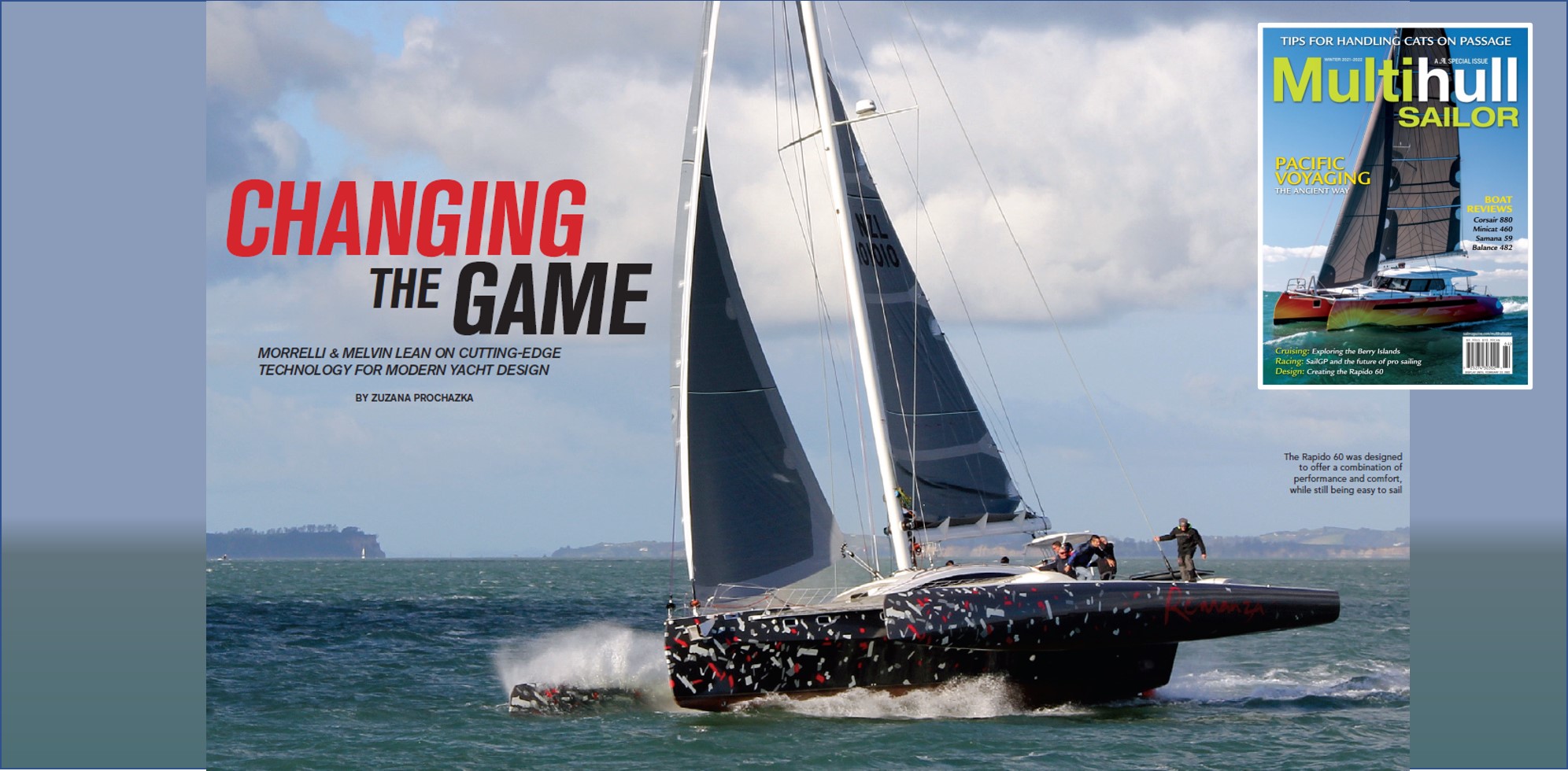
For decades, advances in high-performance yacht design were largely confined to elite racing programs like the America’s Cup and grand prix circuits. Today, those exact engineering breakthroughs are trickling down into performance-cruising boats, leveraging advanced technology to deliver highly sophisticated platforms within reach of cruising sailors.
In a technical feature titled Cutting Edge Technology for Multihull Design, Zuzana Prochazka from SAIL Magazine explored the engineering, advanced design tools, and performance innovations behind the Rapido 60, describing the platform as a true “game changer”.
Drawing on insights from Erik Berzins, yacht designer and partner at the renowned multihull architecture firm Morrelli & Melvin, the feature strips back the design process into three distinct phases, showing how advanced composite construction, multi-variable fluid modeling, and rigorous physical testing combine to create an uncompromised offshore cruising trimaran.
Below are the core engineering takeaways from the feature, proving why the physics-backed architecture of the Rapido 60 stands out to blue-water skippers seeking performance, safety, and structural integrity.
Why SAIL Magazine Considers the Rapido 60 “a Game Changer”
The Three Developmental Stages of the Rapido 60
The architectural process behind the Rapido platform relied on a structured three-phase development lifecycle to ensure complete consistency, oversight, and calculated structural safety:
- Part I – Concept Development & Load Parameters
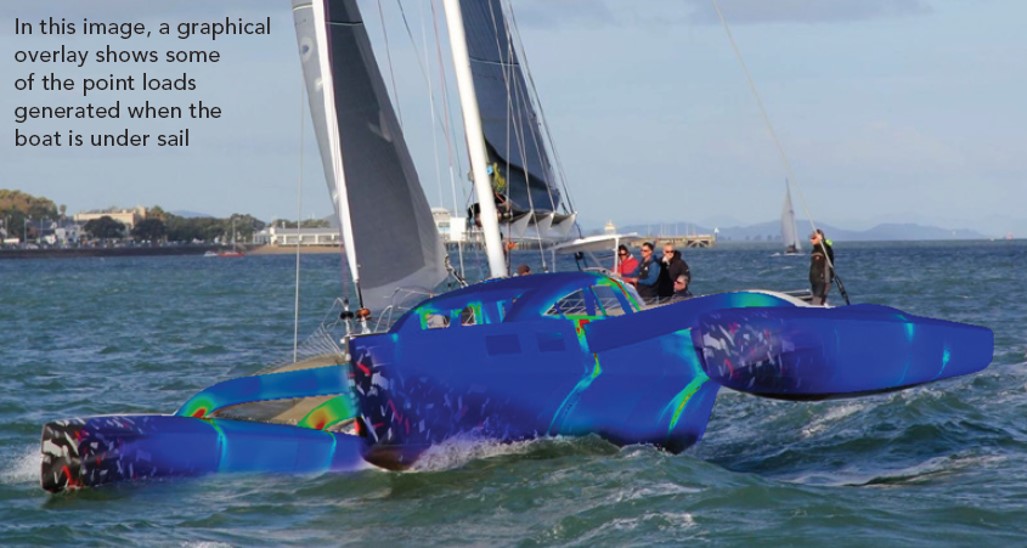
Every design begins with a strict design brief.For the Rapido 60, the mandate was to combine the single-level living and stability of a catamaran with the premium characteristics of an upmarket monohull, entirely removing the dead weight of a lead keel. - Because a trimaran can fly its central hull at 12-13 degrees of heel, maximum load estimates are critical. “You’re basically picking up the entire boat by the shrouds, so strength is imperative, and these loads need to be distributed throughout the platform efficiently.”
Part II – Structure and Performance Analysis
Morrelli & Melvin retained all analysis in-house to maintain collaborative oversight, applying four highly advanced engineering tools:
- Finite Element Analysis (FEA): Dialing in hull strength and identifying the unique load paths of the discontinuous beams to add structural reinforcement only where required, preserving a lightweight, high-speed platform.
- Computational Fluid Dynamics (CFD): Optimizing hull geometries and monitoring fluid flow behavior across varying displacement states to analyze canoe body shape, slamming indices, and minimize hull-form drag.
- Fluid Structure Interaction (FSI): Calculating exact foil deformation under stress to ensure the daggerboard and rudder bend and twist predictably through varying wind and sea conditions.
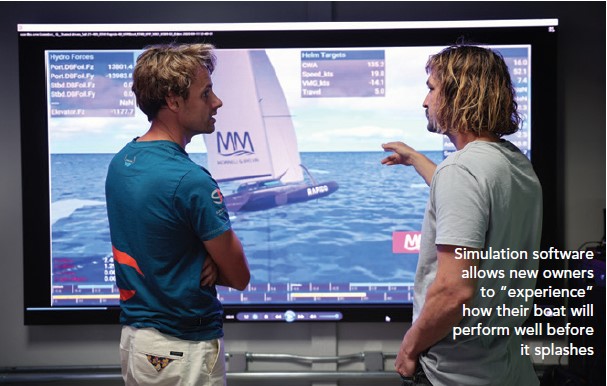
- Velocity Prediction Program (VPP): Generating exact performance polars across all wind angles using GOMBOC, the simulation software developed for Emirates Team New Zealand’s America’s Cup campaigns, to evaluate real-world “sailability” and optimize autopilot interaction.
- Part III – Rigorous Design Validation
With construction underway, real-world structural data was verified against the initial FEA mapping.Full-size rudders and daggerboards were placed in custom test jigs to measure physical deflection under load. For global platform verification, the first completed Rapido 60 was secured to the ground while industrial cranes applied over 10 tons of physical force to twist and load the structure.This testing validates fabrication techniques and gives absolute peace of mind, breaking components in the controlled environment of the yard rather than out on the open ocean.
“The result of all this work is a modern marvel… Under its hood, the boat has the benefits of all the tools and analysis used by one of the leading multihull design firms in the world.” — Zuzana Prochazka, SAIL Magazine
The Result: A New Generation of Offshore Cruising Trimaran
The Rapido 60 represents a calculated shift away from high-displacement, traditional cruising options. By leveraging advanced carbon composites, intensive computational fluid dynamics, and physical load testing, Morrelli & Melvin engineered a bluewater platform that successfully delivers racing-derived velocity without compromising short-handed safety or living comfort.
For bluewater sailors, this meticulous design methodology results in safe, predictable foil performance, faster offshore transits, and a structural framework validated to withstand volatile ocean states.
Frequently Asked Questions
FAQ #1 – Who designed the Rapido 60?
The initial platform concepts were forged in discussions between Paul Koch of Rapido Trimarans and Pete Melvin. Comprehensive naval architecture, structural engineering, and software analysis were executed by Morrelli & Melvin.
FAQ #2 – Why did SAIL Magazine call the Rapido 60 a game changer?
The publication highlighted the rare synthesis of grand prix racing technologies, including pre-preg carbon beam construction, FEA load path mapping, and CFD flow optimization, into a highly stable, immensely livable offshore platform manageable by a shorthand crew.
FAQ #3 – How fast is a Rapido 60?
Under comfortable control at the helm, the Rapido 60 is fully capable of ocean passage speeds exceeding 25 knots.
FAQ #4 – Is the Rapido 60 suitable for serious bluewater cruising?
Yes. The trimaran is designed and certified to CE Category A standards, meaning it is engineered to handle offshore ocean transits. It is actively used for global family exploration, including Riley and Elayna of Sailing La Vagabonde and their two young children.
FAQ #5 – What makes the Rapido 60 different from a performance catamaran?
It has roughly half the total displacement of a comparable 60-foot performance catamaran with an equivalent sail plan. Furthermore, the trimaran architecture harnesses its wider beam to deliver superior righting moment , maximizing stability without the penalty of dragging a heavy lead keel.
FAQ #6 – Where are Rapido Trimarans built?
Rapido Trimarans are built in HCMC, Vietnam. They can be sailed or shipped to anywhere in the world.
Continue Exploring Rapido Trimarans
- Rapido 60: Discover the Flagship Details
- Owner Review: Why I Chose a Rapido Over a Monohull, by Steve Bourne
- Owner Log: What We Learned Crossing the Tasman Sea
- Sailing La Vagabonde Selects the Rapido 60 Platform
- Explore the Rapido 53XS Web Page
- Meet the New Rapido 63 Architecture
- Extreme Expedition: Picomole (Rapido 53XS) Crosses the Drake Passage to Antarctica