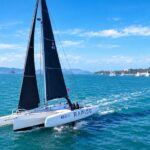
Before Riley and Elayna Whitelum of Sailing La Vagabonde took delivery of their own Rapido 60, they spent a few days sailing a Rapido 50 — camera rolling, as it always is. What followed wasn’t a scripted review. It was an experienced offshore sailor watching numbers on a screen that defied everything he’d experienced before, and reacting in real time.
Before we begin, one point of context: the crew encountered problems with the in-boom furling system, which was supplied independently of Rapido, to this particular boat. But back to the Rapido 50 itself, their observations paint a remarkably consistent picture of the R50 as a platform they describe as “astonishing”. Repeatedly.
1. “Astonishing… Incredible”: Matching and Exceeding the Wind
Early in the sail, in a building breeze, the numbers on the instruments stopped making sense to Riley — in the best possible way.
Screenshot above. Click to play video.
Timestamp: 20:41–20:57
“We were just doing… true wind is 9.2 and we’re doing 9.1. We’re doing wind speed with a triple reefed main. That is astonishing. We’re going to need a faster drone.”
Not long after, with only a J1 headsail up — no reacher, nothing large — it happened again, only more so:
Timestamp: 21:42–22:19
“That’s incredible. And that’s not a big sail. It’s a J1. That’s not even a reacher. We’re doing 9.7 in 9.5 knots of wind. We’re going above windspeed this is bonkers. You can feel us getting sucked… Can you feel that? Oh… oh…, this is nuts!”
By the end of the day, Riley was choosing his words carefully — for him — before giving up on being careful at all:
Timestamp: 23:19–23:30
“This has actually been, I want to say ‘the’ but I’ll be a little bit careful and I’ll say, ‘One of the best sails of my entire life.'”
2. Ghosting Through the Light Stuff: “It’s absolutely bonkers”
What stood out just as much as outright speed was how little wind the boat needed to move at all — and how it carried momentum between gusts in a way Riley said he’d never experienced before.
Timestamp: 23:55–24:31
“This is the first indication that I’ve had that this boat, or our boat, the Rapido 60, might be able to do 1.4 times the speed of the wind, as promised. We’re on the far side of an island. There’s barely a breath of wind. There’s a gust there to 10 knots and we’re doing 9.2. You might be thinking, ‘Well that’s not even wind speed…’. We’ve (only) got a small light wind, upwind sail up and a triple reefed main. A triple reefed main!”
Timestamp: 24:41–25:29
“So we’ve just got no sail up and we’re just coasting along on the leeward side of this island. I went to put the sails away and then there was just a puff of wind to 5 knots and we went from 2 knots because it was slowing down and voom, it just went straight up to 5 knots and then it died down again to 3 knots so we were only going 3 knots and then there was another puff to 7 and bang, up we went again to 7 knots.
It’s like… that is absolutely unheard of. Like, that really is incredible. It’s the sort of sailing that I imagined, that I dreamed, that might be the case in these boats. And it’s happening right now. It’s absolutely bonkers.”
Timestamp: 26:20–27:39
“Sailing on the other side of obstacles or geographical formations like (these islands)… It’s beautiful because the water’s nice and calm, and you can coast, and you really get a lot out of the puffs of wind.
But it can be really frustrating if you have a boat that isn’t powerful enough to get you from gust-to-gust-to-gust-to-gust. And what I’m finding with this boat – where I never have ever before, and even with 3 reefs in the main (and this is the reason why I’m just losing my mind) – is that in the past, we’re able to generate such power that it’s carrying me from one to another to another.
And I can just feel… it’s not very, um, objective, but I can just feel the power behind the vessel. So, it’s the first time I’ve been really, really excited because if I can tie together gust after gust after gust on the leeward side of islands, that’s really, really beautiful sailing.
As a sailor, a large part of my frustration that I’ve experienced in the past – I can just feel evaporate.
Now I’m very happy because one of the things that I hoped might happen is definitely, definitely gonna happen.”
3. Real-World Usability Transcends into Beautiful “Finger of God Zone”
The theme kept repeating: small sail area, massive results, and short-handed ease.
Timestamp: 40:20–40:31
“We’ve got one headsail on. That’s it. We’re just motoring out of the harbor, unfurling one sail and doing 9 1/2 knots in 15 knots downwind… It’s just bonkers.”
Screenshot above. Click to play video.
Timestamp: 41:20–42:05
“Today we’re doing wind speed with 3 – that would be 3 reefs in the main — which is like, no sail up. It’s crazy.
It’s insane to have such little sail up in 10 knots of true wind and we are doing 10 knots true with a normal sized headsail out. It’s not a big sail. To be doing this, it’s just insane.
I don’t know if I said the other day to you guys but Forrest and I have been laughing because it feels like the Finger of God has descended from the heavens and it’s just pushing us along.
We’re in the Finger of God’s Zone again at the moment and it’s just the most incredible, beautiful feeling.”
4. “You Feel Pretty Invincible”: Managing the Trimaran’s Power
Riley closed the section with a message he repeats to anyone considering a boat this powerful — sailors new to multihulls in particular.
Timestamp: 47:15–48:08
“For those of you out there who aren’t experienced multihull sailors, the thing that I said to Toby Hodges from Yachting World (when I did an article with them) and the thing that I will say to anyone who listens in a marina, anywhere, is you don’t need to have your full main up, so, if you’re scared of getting a powerful boat, you’re probably thinking about it wrong.
Maybe you sail around with 1 reef in, or even 2, before you get comfortable with the boat. There’s no reason that you have to go sailing around with everything up.
I think that’s a really important point that most people don’t understand and like, honestly, it’s so weird that people don’t like reefing. Just go through that with your partner regularly and just learn to do it.
Once you do, you feel pretty invincible. Those bigger boats should become way less intimidating.”
5. Rapido 50: “Opens Up Different Worlds”
With real hours on the water under his belt, Riley turned to the practical question a lot of prospective owners ask: how do you decide between models?
Timestamp: 45:49–46:16
“The Rapido 50 – (physically) it’s big. It’s really big. It’s definitely big enough for a family. It’s well set up for a family because it’s got the two rooms.
The thing about this boat, that sets it apart from others, is the wind speed sailing and above wind speed.
That just opens up different worlds. It’s just completely different.
When you’re looking at weather routing and weather systems and when you’re internalizing those numbers and that information… it all just changes. It’s all just completely different.
For example, you might be able to go 200 nautical miles during the daytime which is just astonishing.
We had an absolute ball on board.”
6. Rapido 50 Vs Rapido 60
Timestamp: 46:20–47:14
“For those of you who are wondering, ‘If the 50 is big enough for you, then why go the Rapido 60?’… the answer is waterline length. Waterline length is going to be infinitely more comfortable, which is the same with all multihulls.
Bigger is better, basically. More comfortable. The sea state feels smaller.
If there was a 65 out there for the same price I might take it.
I would be starting to get a little hesitant on a 70-footer because I would be beginning to question whether or not I could single hand that but for the 50 and the 60… The 50 was fine to handle by myself solo and the 60 has, for square meterage of sail, it’s not that much more than the 50 that I think, considering it was my first few days on that boat, um, yeah, it’s going to be easy.”