For many sailors, the true test of a cruising trimaran comes not during a boat show or sea trial, but during a demanding offshore passage.
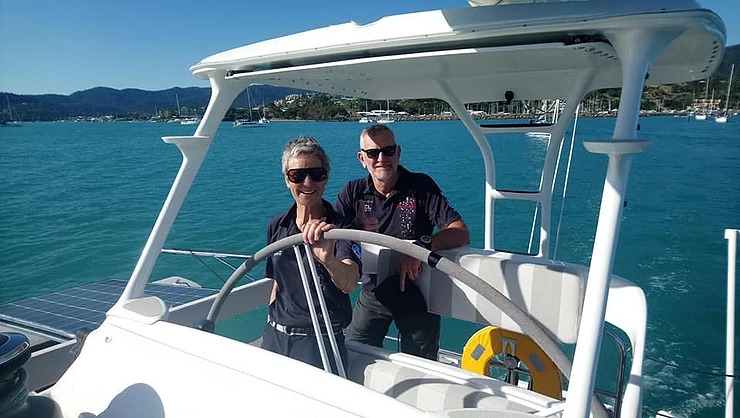
After taking delivery of their Rapido 60, Romanza owners Janice Knowles and Dougall Love completed a crossing of the notorious Tasman Sea between New Zealand and Australia. The passage provided an ideal opportunity to evaluate the boat’s performance, comfort, storage capacity, safety, autopilot systems and overall suitability for long-distance cruising.
Following the crossing, a prospective owner asked a simple question:
“If you could redesign the Rapido 60 today, what would you change?”
Their answer offers valuable insights for anyone considering a Rapido 60 or researching offshore cruising trimarans.
Question to Rapido 60 Owner: What Would You Change After Offshore Cruising?
(Asked by Skiperelli Mac…) Love the boat and really appreciate you sharing the experience on Romanza as well. This is my dream boat and hopefully, one day, I will be able to acquire one as well.
To the owners Dougall and Janice and / or crew, just wondering how have you found the off shore cruising in reality now, with crossing the Tasman Sea etc, with regards to space and placement of items, stability and auto helm options etc?
Is there anything you would do differently now if you designed the new Rapido 60?
Rapido 60 Owners Share Their Real Offshore Cruising Experience
(Rapido 60 owners, Dougall and Jaz Love, reply to Skiperelli Mac…)
The Tasman crossing on Romanza was very easy and even though we went with a crew of six for our first passage, bed spaces worked well with hot bunking during the night watches.
There was more than enough storage room.
We stowed a lot of the dry food in plastic storage boxes under the salon settee and restocked the pantry as needed from there.
The fridge and freezer managed our fresh and frozen food perfectly and we found the induction cooking ideal and fast.
We stowed much of the cruising gear, spares, etc. in the ‘hold’ under the cockpit, again using plastic storage boxes on the shelves we had installed.
We also have our washing machine there, which performed perfectly.
We did stow our deflated dinghy in one of the floats, but otherwise these just stored sails and sheets.
We added (removable) clears around the wheelhouse for the passage and these proved outstanding at creating a warm and comfortable helm station for night watches.
Most of the time we steered by autohelm as it just made life simple. We had no issues with this at all and with 360 amp hours of battery at 24v, solar panels and a Genset as well as the engine, we didn’t ever suffer with low batteries.
The boat was stable, comfortable most of the time and felt very safe.
Much of the sailing time was on full main and jib or Gennaker.
We didn’t experience heavy weather as we routed carefully, and we did spend a lot of time motoring across a big high.
We had a lot of input into the interior layout and finish (of Romanza) and there’s little that we would change as everything worked pretty much as imagined. Some things worked out exceptionally well, like the salon table setup and the chart table.
We love the simplicity of Romanza’s layout and enjoyed the effortless runs of 230+ miles per day.
A great first passage!
Key Takeaways From Romanza’s Tasman Crossing
- The Rapido 60 provided ample storage for a crew of six.
- The induction galley, refrigeration and onboard systems performed reliably offshore.
- The autopilot handled most steering duties comfortably.
- The owners reported excellent stability and safety throughout the passage.
- Average daily runs exceeded 230 nautical miles.
- The owners stated there was very little they would change about their customised layout after the crossing.
Frequently Asked Questions About the Rapido 60
Is the Rapido 60 suitable for offshore cruising?
Yes. Owners Janice Knowles and Dougall Love successfully crossed the Tasman Sea aboard their Rapido 60 “Romanza” and reported a comfortable, safe and enjoyable passage.
How many people can sleep aboard a Rapido 60?
During the Tasman crossing, Romanza carried a crew of six. The owners reported that sleeping arrangements worked well using a watch system and hot bunking.
Does the Rapido 60 have enough storage for long-distance cruising?
According to the owners, there was more than enough storage for provisions, spare parts, cruising equipment and personal gear.
How does the Rapido 60 perform under autopilot?
The owners reported that they used the autopilot for much of the passage and experienced no issues.
Is the Rapido 60 comfortable for ocean passages?
The owners described the boat as stable, comfortable and safe. They also praised the protected helm station and interior layout.
What would the owners change after crossing the Tasman Sea?
Very little. The owners stated that their customised layout worked largely as intended and that several features exceeded expectations.
Useful links
- To view the original question and reply You Tube (in the comments’ section), click here.
- Rapido 60 Owner Review: Why I Chose a Rapido Over a Monohull, by Stephen Bourne
- Rapido 60 web page
- Rapido 53XS web page
- Rapido 53XS, Picomole, sails across Drake Passage to reach Antarctica
- Rapido – cutting edge design and technology by Sail Magazine
Rapido Enquiries
Please email, [email protected]
Built by Triac Composites
Rapido Trimarans are built entirely by Triac Composites, one of Southeast Asia’s leading advanced composite manufacturers.
Every major composite component found on a Rapido—including tooling, molds, hulls, decks, beams, foils, carbon fibre masts and T-foil rudders—is produced by Triac’s in-house team using advanced composite manufacturing techniques, including prepreg carbon fibre construction where specified.
While best known as the builder of the Rapido range, Triac also works with third-party customers worldwide, delivering composite tooling, molds, custom components and complex structures for marine, industrial and specialised engineering applications.
From one-off prototypes to production runs, Triac’s capabilities include prepreg carbon fibre, infused composites, GRP construction, precision tooling and advanced structural composite manufacturing.
To discuss your next composite project, contact [email protected]