Summary
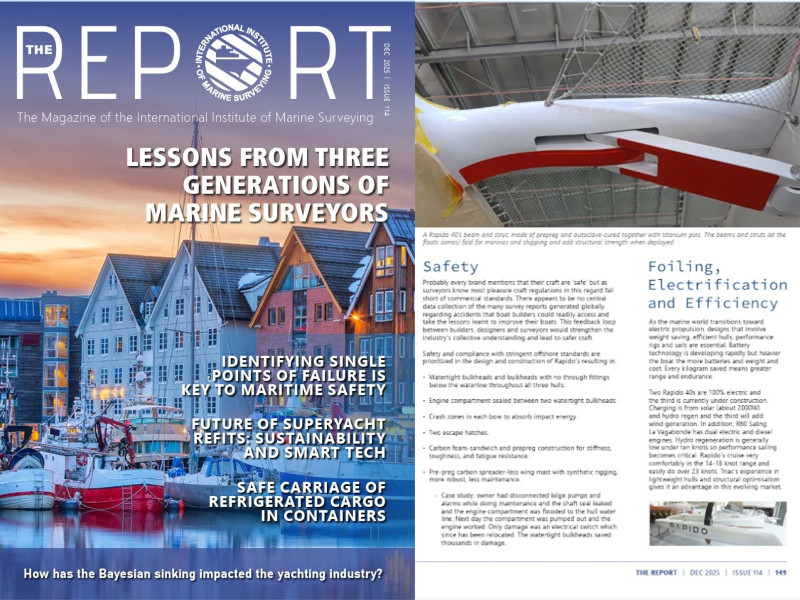
The December 2025 edition of The Report, the official magazine of the International Institute of Marine Surveying, features a four-page article on Triac Composites, the specialist builder behind every Rapido trimaran and Rapido power cat.
As Rapido’s exclusive manufacturing partner, Triac transforms Morrelli & Melvin’s world-class multihull designs into high-performance reality. Through high-precision composite construction, disciplined engineering collaboration and production standards normally seen in elite racing programs, Triac ensures each Rapido is built to exceptional levels of accuracy, strength and reliability.
The article showcases Triac’s extensive in-house capabilities, including prepreg carbon fabrication, autoclave curing, advanced robotic milling, structural analysis and validation, and the full construction of all Rapido models.
For the surveying community, the feature underscores Triac’s deep commitment to safety and structural integrity; from early-stage engineering and controlled processes through to watertight integrity, crash-zone protection and disciplined composite workmanship.
Whether manufacturing Rapido’s performance multihulls, integrating foiling technologies or producing specialised composite components for defence and industry, Triac demonstrates the expertise, precision and consistency required of a truly global composite manufacturer. And the standard that Rapido owners rightfully expect.
-
To read the December 2025 Report Magazine online in e-Reader format or in downloadable pdf format: Report Magazine December 2025
The Original article is reproduced below.
Dear Members and fellow Marine Professionals,
I recently had the pleasure of meeting Mr Phil Johns, Marketing & Business Development Director at Triac Composites Ltd, Vietnam. Phil kindly took me on a tour of their composites factory, where they fabricate impressive components as well as trimarans, racing yachts and leisure craft. I invited Triac to provide this article for our general readership, as I, a big ship surveyor, found the insight into another part of the marine industry fascinating.
Peter Broad, CEng, FIIMS, FIMarEST, Immediate Past President of IIMS
Design, engineering and construction of smaller vessels for safety, performance and the e propulsion future
By Triac Composites Limited, Vietnam
Design, engineering and construction technology utilizing advanced composites are transforming the marine industry by combining exceptional strength, corrosion and fatigue resistance, and design flexibility with lightweight efficiency — all essentials for performance and the future of electric propulsion.
Triac Composites is an internationally owned, Vietnam-based manufacturer that utilizes advanced composite solutions across the marine, defence and industrial sectors.
Outsourced work covers a broad range, including plugs and molds, commercial and private boats, foils, UAVs, and components for commercial vessels such as tug-boat consoles. Triac also builds the high-tech, all-carbon, ocean-cruising Rapido trimaran range (Rapido Trimarans is the parent company) and Rapido’s new lightweight ECO power cats for private and commercial use (see Rapido Catamarans). All components for Rapidos are made in-house, including pre-preg spreader-less wing masts, booms, foils, daggerboards, rudders and even carbon railings and carbon countertops.
Today’s leading performance-cruising boats benefit from trickle-down technology developed in the yacht-racing world, including the America’s Cup, transforming them into highly sophisticated platforms accessible to the average sailor. Triac has leveraged that expertise, together with the knowledge gained from building Rapidos, to compete confidently in high-tech composite manufacturing.
For surveyors – whose work centres on structural integrity, reliability and safety – familiarity with the design, technology, construction methods and testing behind these advanced composite vessels is becoming essential. Designers and engineers of Rapido’s trimarans, the world acclaimed Morrelli & Melvin, organise the design process for each Rapido into three main phases.
The three phases of design and engineering
1. Concept Development
Begins with the design brief. For all Rapido models, it is to create a high-performance, yet livable, multihull that is lightweight, strong (carbon construction), easy to sail (including short-handed), stable, seakindly and safe for offshore (CE Category A). Safety and compliance with stringent offshore standards are prioritized.
-
Includes detailed layout sketches, 3D models and preliminary structural analysis to determine key specifications (weight, length, beam ratios, rigging loads, center of gravity).
Accurate maximum load estimates are critical si that they can be distributed throughout the platform efficiently.
2. Structure & Performance Analysis
Concentrates on the following four main areas, using cutting-edge technology to make it ‘real’.
-
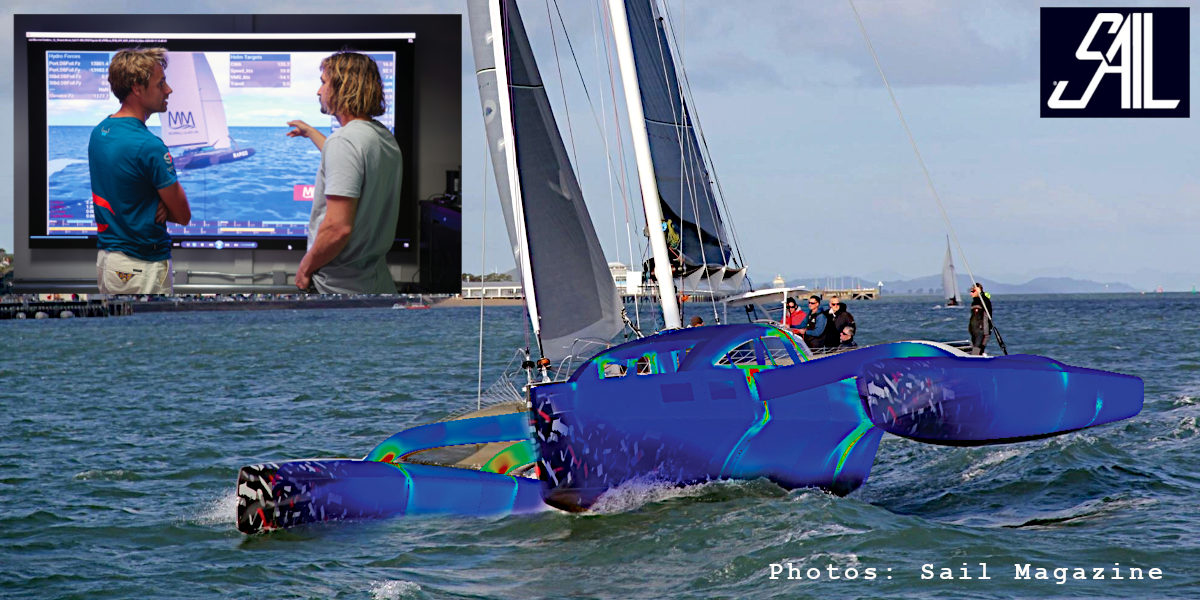
Finite Element Analysis (FEA). The hull’s strength and maximum loads are quantified through simulations equivalent to “sailing in anger,” revealing where failures could occur. This approach keeps the structure as light as possible by adding reinforcement solely where the load paths dictate.
-
Computational Fluid Dynamics (CFD). Flow analysis is used to optimise hull geometry, shapes and appendages for reduced drag, improved stability, better wake behaviour and refined load handling.
-
Fluid-Structure Interaction (FSI). Combines FEA and CFD to assess how structures deform under load (e.g., foils, rudders) and to refine laminate schedules, material stiffness and fibre orientations, ensuring optimised behaviour and safe, predictable performance.
Velocity Prediction Program (VPP): This is used for performance analysis and prediction. Polars are generated to forecast boat speed across a range of true wind speeds and angles, integrating inputs from sailmakers and CFD/FSI. (Simulation software originally developed for the America’s Cup is used.)
3. Design Validation
Boat construction is well underway. Critical components are tested with jigs to validate the accuracy of the loads and stresses used in FEA. The Rapido 60 has a unique design with beams that are plugged into the main hull.
As the first Rapido 60 (Hull #01) neared completion, it underwent an extraordinary structural test. The boat was strapped to the factory floor while two cranes, positioned diagonally opposite each other, lifted each float, twisting the entire structure with up to 9 tons of force. This diagonal load was designed to simulate the rolling and torsional stresses experienced at sea and to confirm the accuracy of the earlier engineering calculations.
This level of testing – severe enough that it could destroy the boat – is normally reserved for multimillion-dollar race yachts. It represents a significant investment risk, but proving the structure in the yard is far preferable to discovering a weakness offshore.
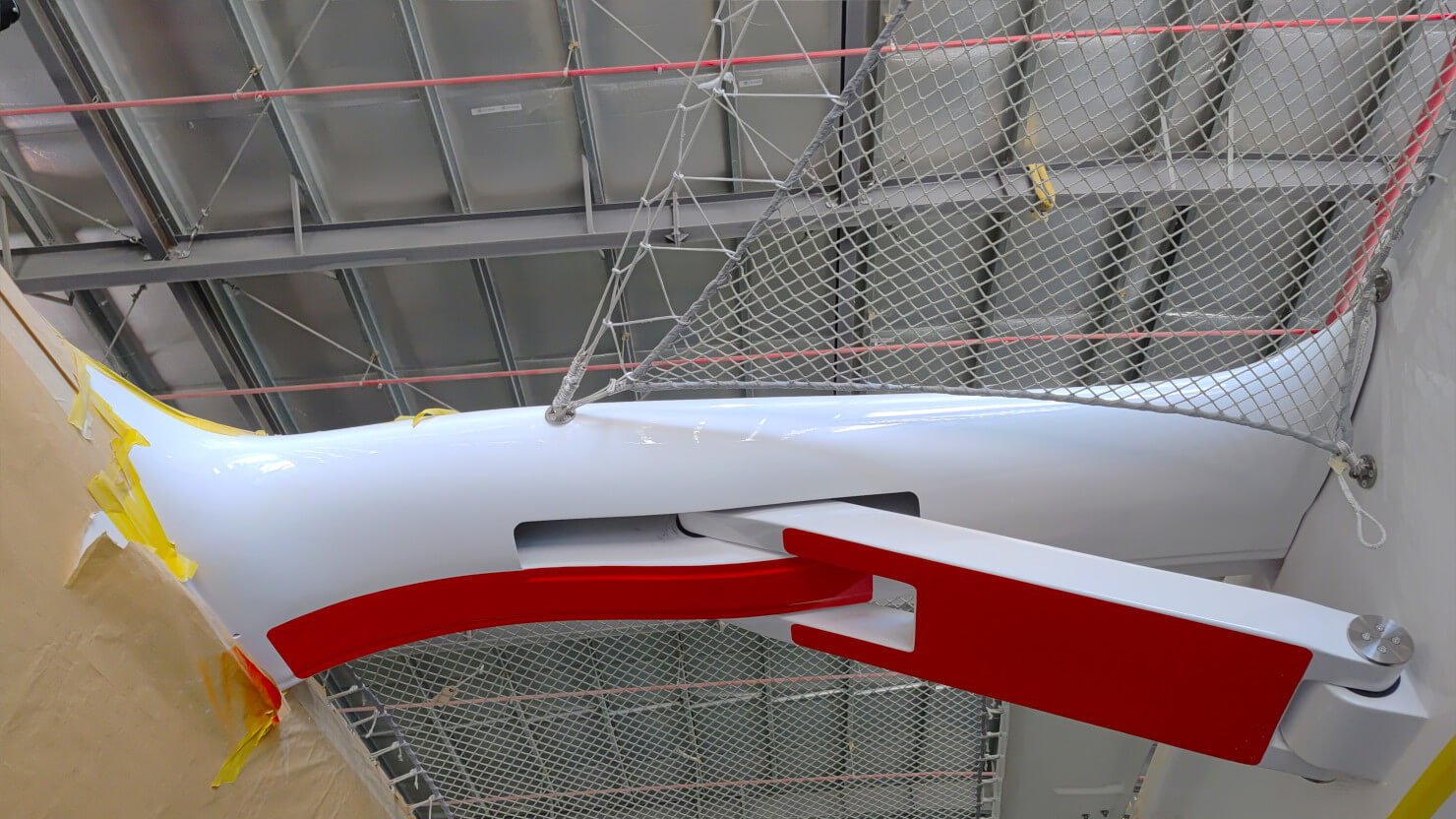
The Rapido 60 and new Rapido 53XS have fixed beams, while the Rapido 50, Rapido 40 Performance Cruiser and Rapido 40 Racer have a folding system that is an integral part of the structure with prepreg carbon beams and struts with titanium pins. The folding system reduces the beam to that of a similar-length monohull, reducing fees for marina wet berths, hard stands and shipping.
Safety
There also appears to be no central repository for the many survey reports generated globally regarding accidents; reports that boatbuilders could otherwise use to improve their products. A strong feedback loop between builders, designers and surveyors would strengthen the industry’s collective understanding and lead to safer craft.
Safety and compliance with stringent offshore standards are prioritized in the design and construction of Rapidos, resulting in:
- Watertight bulkheads and bulkheads with no through-fittings below the waterline throughout all three hulls.
- Engine compartment sealed between two watertight bulkheads.
- Crash zones in each bow to absorb impact energy.
- Two escape hatches.
- Carbon foam-sandwich and prepreg construction for stiffness, toughness, and fatigue resistance.
- Pre-preg carbon spreader-less wing mast with synthetic rigging which is more robust but less maintenance.
Case study: An owner had disconnected the bilge pumps and alarms during maintenance, and a leaking shaft seal flooded the engine compartment up to the hull waterline. The following day, the compartment was pumped dry and the engine started without issue. The only damage was a single electrical switch, which has since been relocated. The watertight bulkheads prevented the flooding from spreading and saved thousands of dollars in potential damage.
Foiling, Electrification and Efficiency
As the marine industry moves toward electric propulsion, weight reduction, efficient hulls, and high-performance rigs and sails become essential. While battery technology is advancing quickly, a heavier boat still requires more batteries – which adds weight and cost. Every kilogram saved directly improves range and endurance.
Two Rapido 40s are 100 per cent electric and a third is currently under construction. With the first two Rapidos, charging is from solar (about 2,000W) and hydro-regen. The third will also have wind generation.
In addition, the You Tubers, Sailing La Vagabonde (Rapido 60 #04) have dual electric and diesel engines.
Hydro-regeneration is typically minimal below ten knots, which means efficient sailing performance becomes essential. Rapidos comfortably cruise in the 14–18 knot range and can readily exceed 23 knots. With Triac’s expertise in lightweight hull construction and structural optimisation, the company is well positioned to meet the demands of this rapidly evolving market.
Foiling: The Next Efficiency Frontier
Fully foiling vessels dramatically increase efficiency by lifting their hulls clear of the water, which sharply reduces wetted surface area and drag. For power-only electric craft, this translates into gains of 30–50 per cent in range and speed.
Hydrofoils that operate in a semi-foiling mode do not elevate the hull entirely, but they still lift it enough to meaningfully reduce wetted surface and drag. The result is a substantial improvement in range, speed, and overall efficiency.
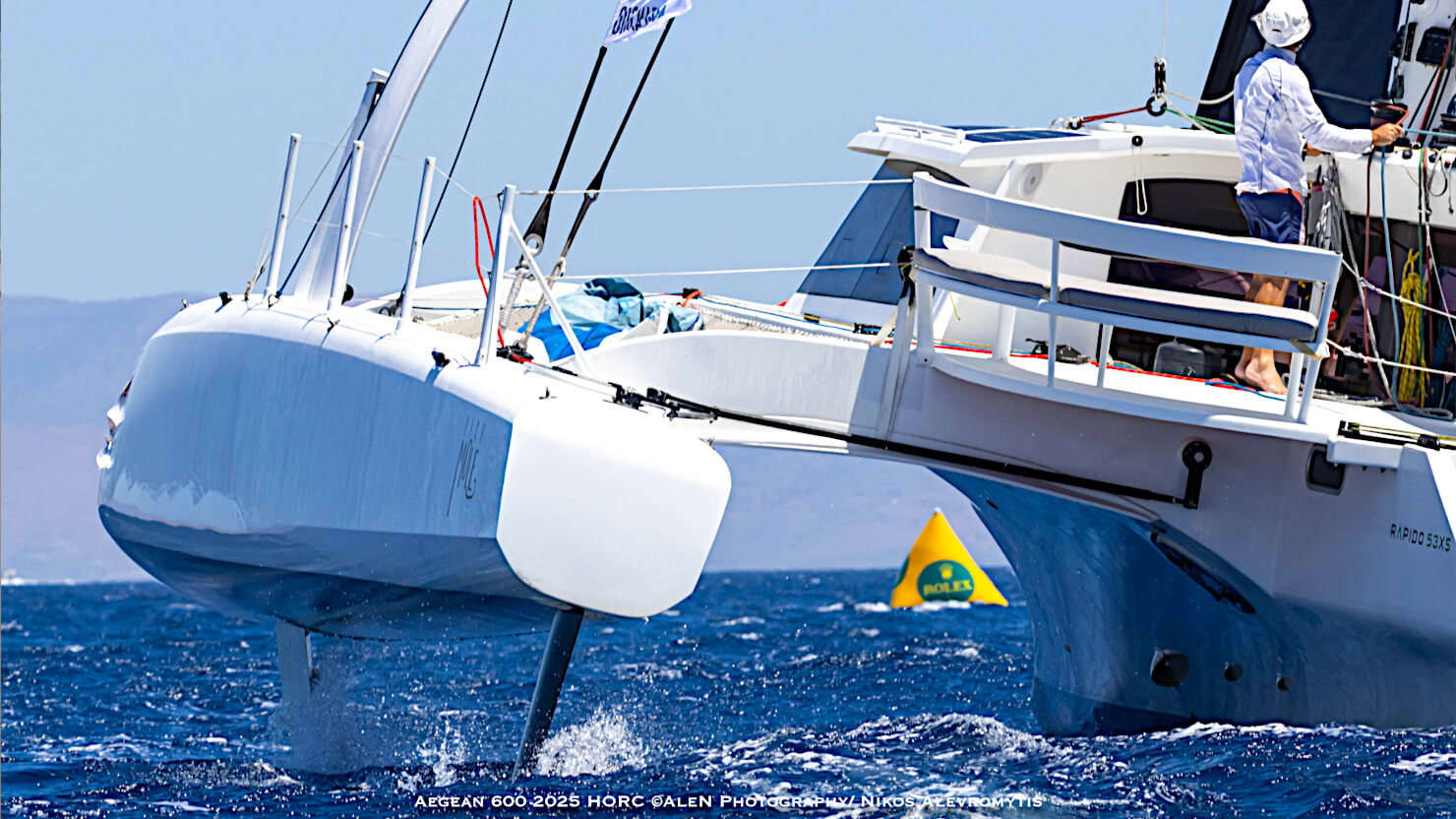
Fully foiling cruising sailing craft for the average sailor may still be in the future, but both the Rapido 40 and Rapido 53XS already incorporate twin C-foils, one in each float. These give additional lift, reduce drag, improve performance, and work in tandem with the rudder-mounted T-foil (which reduces pitching). Together, they deliver greater control, comfort, and speed under sail.
Precision Manufacturing
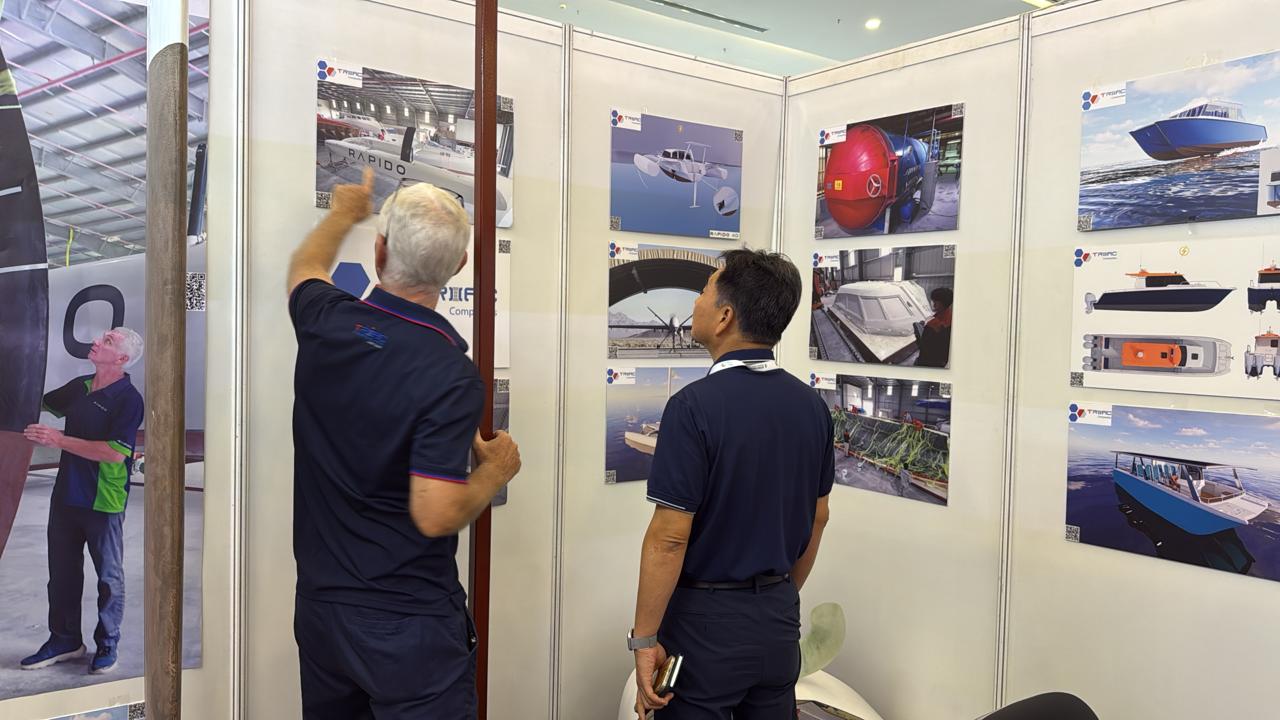
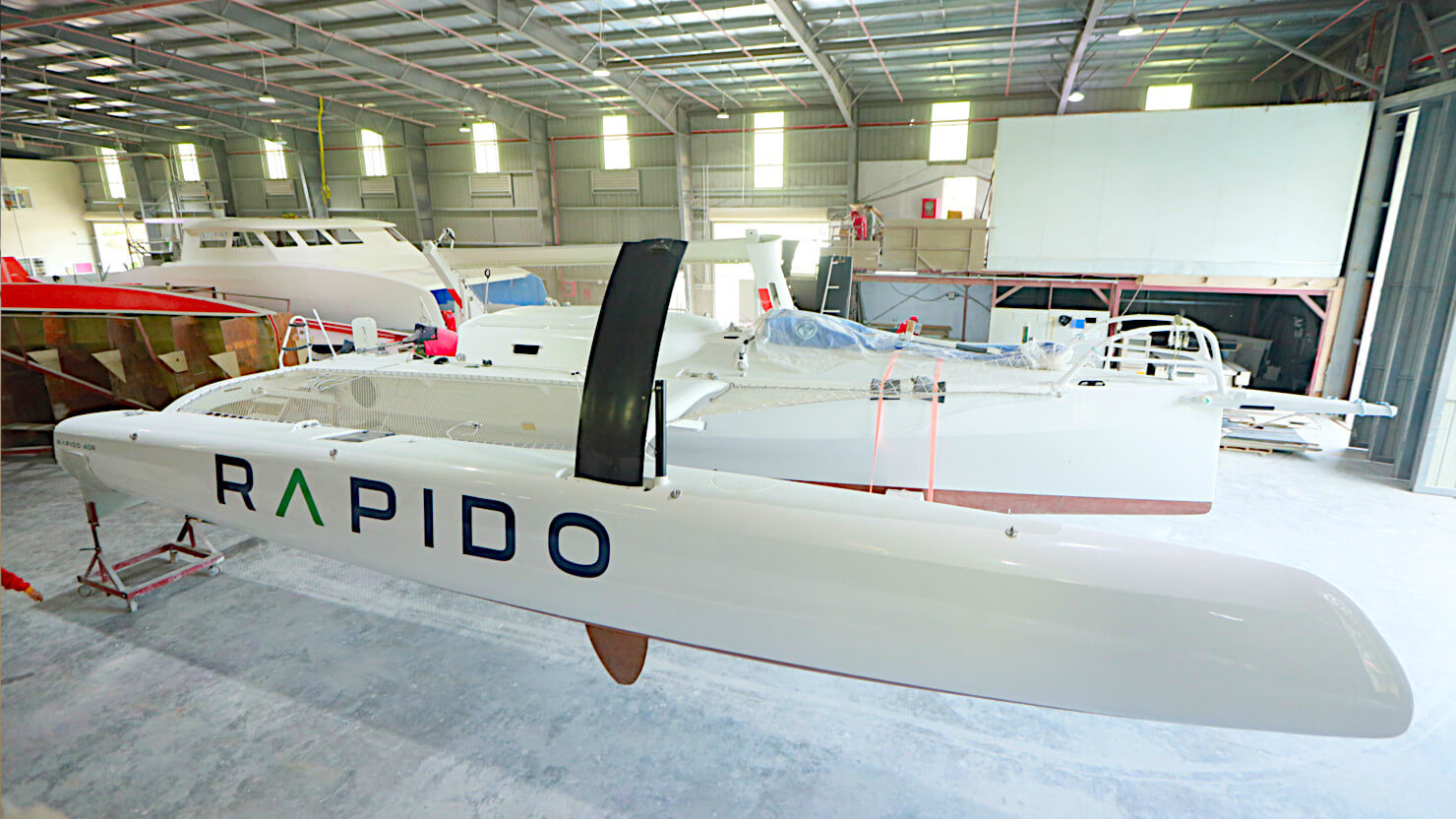
Triac’s manufacturing processes utilize its seven-axis industrial robot, CNC machine, large autoclave (8.5m (length) x 1.8m (diameter)), clean room and paint booth.
The Human Element
Behind the technology is a highly skilled Vietnamese workforce trained in advanced composite processes. Vietnam’s manufacturing sector provides a rich source of talented, disciplined technicians. Through ongoing training and a strong quality culture, Triac ensures that every employee understands not just how to build, but why each process matters. This partnership of local craftsmanship and global expertise enables Triac to deliver world-class precision with the efficiency expected in advanced composite manufacturing.
For more information visit:
- Triac Composites
- Rapido Trimarans
- Related article: Cutting Edge Design for Multihulls, Zuzana Prochazka, 2 March, 2022, Sail Magazine. The magazine takes a detailed, behind-the-scenes look at Morrelli & Melvin’s approach to multihull design, specifically, the Rapido.
Thank you to Richard Eyre, co-founder, Triac Composites & Rapido Trimarans; to Phil Johns; and to all at Triac Composites for this insightful article.
Article arranged by Peter Broad, CEng, FIIMS, FIMarEST, Immediate Past President of IIMS